
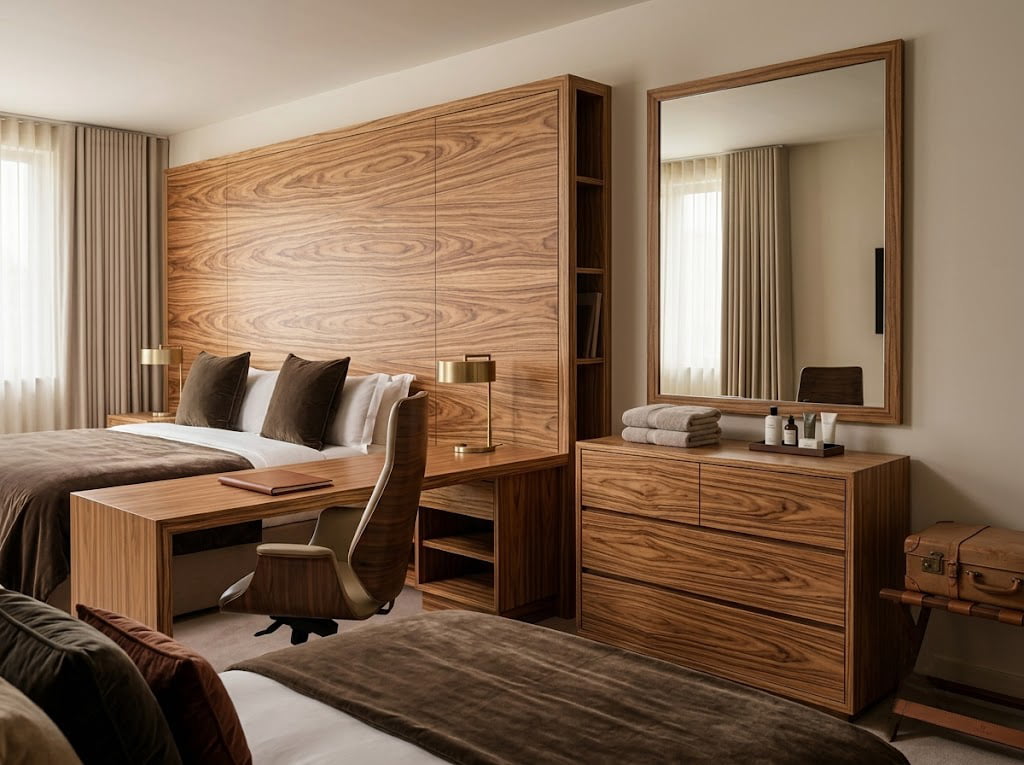
# Tzalam Plywood For Hotel Furniture: The Complete Sourcing and Specification Guide For Hospitality Projects
For **hotel furniture manufacturers, hospitality designers, hotel procurement managers, FF&E consultants, contract furniture companies, hotel renovation contractors, boutique hotel developers, hotel chains, furniture importers serving hospitality, and project managers overseeing hotel furnishing**—the critical challenge isn’t simply finding *affordable* furniture materials or *durable* options—it’s identifying **genuinely superior plywood that delivers authentic hardwood aesthetics, withstands intensive commercial use, meets strict budget parameters, ensures consistent supply across large installations, and maintains appearance quality** throughout the demanding lifecycle of hotel furniture while avoiding the **cost prohibitions of premium hardwoods like walnut, performance inconsistencies of economy materials, supply disruptions of exotic species, and aesthetic limitations** of engineered alternatives. **Tzalam plywood (Lysiloma latisiliquum)**—a sophisticated Mexican hardwood plywood with **walnut-like appearance, exceptional durability, commercial-grade performance characteristics, competitive pricing, and increasingly reliable supply chains**—has emerged as a **strategic material choice for hospitality furniture applications** where success depends on **balancing aesthetic quality, operational durability, project economics, and installation timelines**.
Whether you’re a **hotel furniture manufacturer** establishing material standards for product lines serving 3-5 star properties, **hospitality interior designer** specifying furniture packages for boutique hotels or major renovations, **FF&E procurement specialist** managing furniture budgets for 100+ room properties, **hotel developer** making material decisions affecting project feasibility, **contract furniture importer** evaluating wood species for hospitality collections, **hotel chain purchasing director** standardizing specifications across multiple properties, **renovation contractor** sourcing materials for phased hotel updates, **furniture fabricator** bidding on hospitality projects, **hotel owner/operator** evaluating furniture replacement options, or **project manager** coordinating furniture delivery for new hotel openings—understanding **tzalam plywood’s specific advantages for hotel furniture, proper commercial-grade specifications, durability testing standards, installation logistics, maintenance requirements, cost analysis, and sourcing strategies** transforms material selection from **reactive purchasing into strategic decisions** that impact guest satisfaction, operational costs, renovation cycles, and project profitability.
Most hospitality professionals encounter tzalam through **competitive analysis**—noticing furniture quality at Mexico resort properties, supplier presentations, cost-saving initiatives, or design inspiration from Latin American hotels—and initially make expensive mistakes: **inadequate specification rigor resulting in substandard quality, insufficient durability testing before large-scale purchase, poor supplier vetting leading to inconsistent quality, underestimating lead time requirements, failing to coordinate material selection with other FF&E elements, not establishing clear quality acceptance standards, inadequate samples causing design mismatches, missing opportunities to leverage Mexico sourcing advantages, and failing to properly evaluate total cost of ownership** versus initial material cost.
This comprehensive technical guide addresses every critical question hospitality furniture professionals must answer: **What makes tzalam suitable for commercial hotel furniture versus residential applications? How do you specify commercial-grade tzalam plywood? What performance testing should be required? How does durability compare to traditional hotel furniture species? What are realistic cost comparisons for complete furniture packages? How do you ensure quality consistency across large orders? What are lead time and logistics considerations? How do you evaluate and qualify suppliers? What finishing specifications deliver long-term durability? How do you calculate total cost of ownership? What maintenance protocols extend furniture life? How do you manage phased installations and future replacement needs?**
—
## Section 1: Why Tzalam Plywood Works For Hotel Furniture
### Commercial Performance Requirements Hotels Actually Need
**Performance Requirement #1: Durability Under Intensive Use**
**Understanding Hotel Furniture Stress Levels:**
**Guest Room Furniture Usage Reality:**
**Typical 3-4 Star Hotel Guest Room:**
– **Annual occupancy:** 70-85% = 255-310 nights occupied
– **Average length of stay:** 2.3 nights
– **Guest cycles per year:** 110-135 different guests using same furniture
– **Useful furniture life expectation:** 7-10 years before major renovation
– **Total usage cycles:** 770-1,350 different users over furniture lifetime
**Compared to Residential:**
– **Home bedroom furniture:** 2 primary users; 10-15 year typical lifecycle
– **Hotel equivalent:** 50-65× more users over similar timeframe
– **Stress factors:** Unfamiliarity with furniture; lack of ownership care; luggage impacts; variable user sizes/weights; cleaning chemical exposure
**Specific Furniture Piece Stress Analysis:**
**Headboard:**
– **Impact stress:** Luggage thrown on bed; guests leaning against
– **Surface stress:** Hand oils, hair products, cosmetics, food/beverage spills
– **Cleaning exposure:** Disinfectants, sanitizers (especially post-COVID protocols)
– **Attachment stress:** Wall-mounting hardware under repeated stress
**Nightstands:**
– **Surface abuse:** Hot beverages, cold glasses (condensation), cosmetics, electronics
– **Drawer operation:** 150-200 open/close cycles per year × 7-10 years = 1,050-2,000 cycles
– **Impact damage:** Luggage bumps, dropped items
– **Weight stress:** Guest belongings, lamps, alarm clocks, phones
**Desks/Work Surfaces:**
– **Surface pressure:** Laptop use, writing pressure, leaning weight
– **Thermal stress:** Hot electronics, beverages
– **Chemical exposure:** Spills, cleaning products
– **Edge wear:** Chair bumps, arm resting
**Dressers/Armoires:**
– **Drawer cycling:** 200-250 cycles annually × 7-10 years = 1,400-2,500 cycles
– **Weight capacity:** Heavy clothing, guest belongings
– **Door stress (if applicable):** Frequent opening/closing, hinge strain
– **Surface abuse:** Similar to nightstands
**Tzalam Plywood’s Durability Profile:**
**Janka Hardness Comparison:**
| Wood Species | Janka Hardness (lbf) | Hospitality Suitability |
|————–|———————|————————|
| **Tzalam** | **1,750** | **Excellent – commercial grade** |
| Hard Maple | 1,450 | Good – standard hospitality |
| Red Oak | 1,290 | Good – traditional choice |
| Black Walnut | 1,010 | Moderate – shows wear faster |
| Cherry | 950 | Moderate – premium aesthetics but softer |
| Birch (Yellow) | 1,260 | Good – common budget choice |
| Alder | 590 | Poor – too soft for hotel use |
**Why Janka Matters in Hotels:**
– **Surface dent resistance:** Higher hardness = fewer visible dents from impacts
– **Edge durability:** Plywood edges (exposed in drawer boxes, shelves) resist chipping
– **Finish longevity:** Harder wood = finish less prone to abrasion through to bare wood
– **Long-term appearance:** Maintains “newer” look longer between renovations
**Real-World Performance Data:**
**Case Example: 120-Room Boutique Hotel Chain (Mexico/Caribbean)**
**Material:** Tzalam plywood furniture package (beds, nightstands, desks, dressers)
**Installation:** 2017
**Current status (2025):** 8 years in service
**Average occupancy:** 78%
**Condition Assessment:**
– **Surface quality:** 85% of pieces show minimal wear; finish intact
– **Structural integrity:** No joint failures; no drawer box replacements needed
– **Operational status:** All drawers/doors operating properly
– **Refinishing needs:** 12% of pieces showing finish wear in high-contact areas (expected at this lifecycle point)
– **Replacement rate:** 3% annual replacement (damage incidents, not wear-out)
**Compared to Previous Furniture (Birch plywood):**
– **Previous lifecycle:** Required partial replacement at year 6; full renovation at year 8
– **Tzalam performance:** Extended useful life by 25-30%
– **Cost impact:** Delayed $380,000 renovation by 2+ years
—
**Performance Requirement #2: Finish Durability and Maintenance**
**Hotel Furniture Finishing Challenges:**
**Why Residential Finishing Standards Fail in Hotels:**
**Residential Environment:**
– **Cleaning frequency:** Weekly dusting; occasional deep cleaning
– **Cleaning products:** Gentle household cleaners; often just damp cloth
– **Chemical exposure:** Minimal; carefully applied
– **Damage control:** Immediate attention to spills; protective measures (coasters, placemats)
**Hotel Environment:**
– **Cleaning frequency:** Daily room cleaning; deep cleaning at each checkout
– **Cleaning products:** Industrial disinfectants; multi-surface cleaners; COVID-protocol sanitizers
– **Chemical exposure:** Daily contact with aggressive chemicals
– **Damage control:** Delayed spill cleanup; no protective measures; guest carelessness
**Finish Failure Modes in Hotels:**
**Chemical Degradation:**
– **Symptom:** Finish becomes cloudy, rough, or sticky
– **Cause:** Cleaning chemicals breaking down finish (especially lacquers, shellacs)
– **Timeline:** Can occur within 12-24 months with aggressive cleaners
– **Cost impact:** Requires professional refinishing or replacement
**Abrasion Wear-Through:**
– **Symptom:** Finish worn away in high-contact areas (drawer fronts, desk edges, nightstand tops)
– **Cause:** Repeated friction from hands, objects, cleaning
– **Timeline:** 3-5 years for inadequate finishes; 7-10 years for proper finishes
– **Cost impact:** Localized touch-up possible; full refinishing preferred
**Moisture Damage:**
– **Symptom:** White rings, finish bubbling, delamination
– **Cause:** Water/beverage exposure penetrating finish
– **Timeline:** Can occur immediately with finish defects or inadequate protection
– **Cost impact:** Often requires replacement (difficult to repair invisibly)
**Tzalam’s Finishing Advantages for Hospitality:**
**Substrate Quality:**
**Smooth, Consistent Surface:**
– **Grain structure:** Moderately fine texture; not heavily figured
– **Pore structure:** Semi-closed pores (less open than oak; not tight-closed like maple)
– **Sanding efficiency:** Reaches finish-ready condition with less labor
– **Finish advantage:** Smooth substrate = better finish adhesion and durability
**Even Absorption:**
– **Stain consistency:** Accepts stains uniformly (critical for matching pieces across large orders)
– **Finish penetration:** Sealers and topcoats absorb evenly
– **Color predictability:** Reduces variation in finished appearance
– **Quality control:** Easier to achieve consistent results across production runs
**Recommended Hotel-Grade Finishing Systems:**
**System #1: Conversion Varnish (Professional Standard)**
**Characteristics:**
– **Chemistry:** Two-component catalyzed finish; chemical cure (not air-dry)
– **Durability:** Excellent chemical resistance; superior abrasion resistance
– **Application:** Professional spray equipment required
– **Cost:** $12-18 per piece additional finishing cost (vs standard finishes)
**Performance:**
– **Chemical resistance:** Withstands typical hotel cleaning products
– **Abrasion:** 2-3× longer wear life than nitrocellulose lacquer
– **Moisture resistance:** Good protection against water/beverage damage
– **Maintenance:** Can be cleaned with standard hotel cleaning protocols
**Hotel suitability:** ★★★★★ Optimal choice for commercial hospitality
**System #2: Pre-Catalyzed Lacquer (Good Budget Option)**
**Characteristics:**
– **Chemistry:** Modified lacquer with enhanced durability
– **Durability:** Better than standard lacquer; not equal to conversion varnish
– **Application:** Standard spray equipment
– **Cost:** $6-10 per piece additional cost
**Performance:**
– **Chemical resistance:** Moderate; adequate for most hotel applications
– **Abrasion:** Good; 50% better than standard lacquer
– **Moisture resistance:** Adequate with proper application
– **Maintenance:** Compatible with gentle commercial cleaners
**Hotel suitability:** ★★★★☆ Good choice for budget-conscious 3-star properties
**System #3: Waterborne Polyurethane (Emerging Option)**
**Characteristics:**
– **Chemistry:** Water-based polymer finish
– **Durability:** Improving formulations approaching solvent-based performance
– **Application:** Spray or wipe-on possible
– **Cost:** $8-14 per piece
**Performance:**
– **Chemical resistance:** Good; less affected by alcohol-based cleaners
– **Abrasion:** Good to very good (formula dependent)
– **Moisture resistance:** Excellent
– **Environmental:** Low VOC; easier compliance with regulations
**Hotel suitability:** ★★★★☆ Increasingly popular for eco-conscious properties
**System #4: UV-Cured Finish (High-Volume Production)**
**Characteristics:**
– **Chemistry:** Ultraviolet light-cured polymers
– **Durability:** Excellent; extremely hard surface
– **Application:** Specialized UV equipment required; factory-only
– **Cost:** $10-15 per piece (amortized across high volume)
**Performance:**
– **Chemical resistance:** Excellent
– **Abrasion:** Superior; extremely durable
– **Moisture resistance:** Excellent
– **Speed:** Instant cure; enables rapid production
**Hotel suitability:** ★★★★★ Ideal for large orders (50+ rooms)
**Finishing Specification Language for Hotel Furniture RFQs:**
**Sample Specification:**
*”All tzalam plywood surfaces shall receive commercial-grade finish system consisting of:*
*1. Surface preparation: Sanding to 180-grit minimum; clean, dust-free*
*2. Stain (if specified): [Color name/number]; even application; no streaking*
*3. Sealer coat: Sanding sealer appropriate to topcoat system; light sanding after cure*
*4. Topcoat: Minimum three (3) coats conversion varnish or pre-catalyzed lacquer; 4-5 mils dry film thickness*
*5. Sheen: Satin (25-35 gloss units) unless otherwise specified*
*6. Curing: Full cure per manufacturer specifications before packing*
*7. Quality: Smooth, uniform appearance; no runs, sags, orange peel, or contamination*
*Finish shall withstand:*
*- 100 double-rubs with MEK solvent (per ASTM D5402)*
*- KCMA water resistance test (24-hour exposure)*
*- Standard hotel cleaning product exposure without degradation”*
—
**Performance Requirement #3: Dimensional Stability Across Climate Zones**
**Why Stability Matters in Hotel Installations:**
**Hotel Furniture Faces Variable Conditions:**
**Environmental Stress Factors:**
– **HVAC cycling:** Rooms vacant = HVAC setback or off; occupied = full cooling/heating
– **Humidity fluctuations:** Bathrooms create humidity spikes; dry seasons vs rainy seasons
– **Rapid changes:** Guest adjusts thermostat drastically; windows opened in coastal locations
– **Geographic extremes:** Desert hotels (very dry); tropical resorts (very humid); mountain lodges (temperature extremes)
**Consequences of Poor Stability:**
**Door/Drawer Operational Issues:**
– **Swelling:** Doors/drawers become difficult to open (guest complaints)
– **Shrinkage:** Gaps appear; doors don’t close properly; unprofessional appearance
– **Seasonal variation:** “Works fine in winter, sticks in summer” = ongoing maintenance burden
**Structural Problems:**
– **Joint failure:** Case construction joints separate from movement stress
– **Panel issues:** Raised panels crack or split; panel-in-frame construction fails
– **Warping:** Doors twist; drawer fronts cup; surfaces no longer flat
**Aesthetic Degradation:**
– **Finish checking:** Wood movement causes finish to crack
– **Veneer failure:** Face veneer may check or delaminate with extreme movement
– **Visible gaps:** Joints open up; unprofessional appearance
**Tzalam Plywood’s Stability Performance:**
**Movement Characteristics Review:**
– **Tangential shrinkage:** 7.1% (favorable)
– **Radial shrinkage:** 4.2% (moderate)
– **Stability rating:** Good to Very Good (for hardwood)
**Plywood Stability Advantage:**
**Why Plywood Outperforms Solid Wood:**
**Cross-Grain Construction:**
– **Principle:** Alternating grain direction restricts movement
– **Effect:** Plywood moves 80-90% less than solid wood of same species
– **Cabinet benefit:** Panels remain flat; drawer boxes maintain dimensions
**Real Movement in Service:**
**Solid Tzalam (Hypothetical):**
– **24″ wide panel:** Could expand/contract 0.15-0.25″ with seasonal changes
– **Hotel impact:** Drawers would bind; doors wouldn’t close properly
**Tzalam Plywood:**
– **Same 24″ panel:** Actual movement 0.02-0.03″ (negligible)
– **Hotel impact:** No operational issues;
Comments