
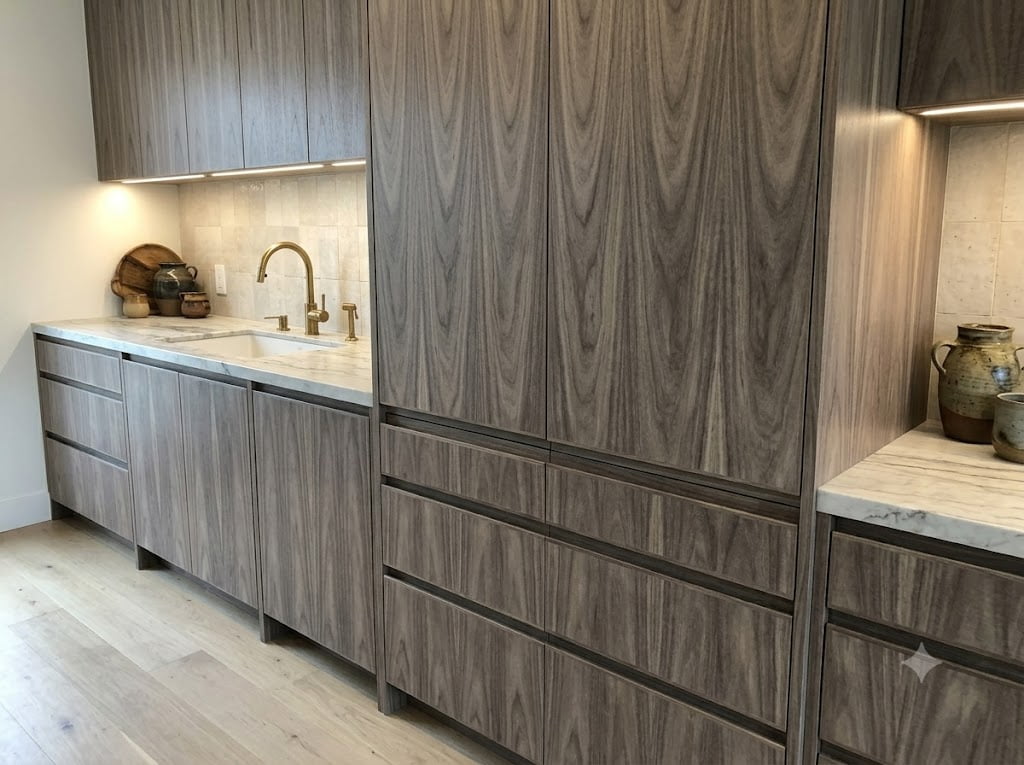
# Tzalam Plywood For Cabinets: The Complete Guide To This Premium Mexican Hardwood For Kitchen, Bathroom, And Custom Cabinetry Applications
For **cabinet manufacturers, kitchen and bath designers, custom millwork shops, residential builders, commercial contractors, remodeling companies, cabinet wholesalers, architectural millwork firms, furniture makers with cabinet divisions, and cabinetry importers** who balance **client expectations for premium aesthetics, durability requirements, budget constraints, and production efficiency**—the fundamental challenge isn’t finding *any* wood for cabinets—it’s identifying **genuinely superior materials that deliver rich hardwood appearance, excellent workability, dimensional stability, competitive pricing, and reliable supply** while avoiding the **cost premiums of traditional species like walnut, cherry, and oak** or the **aesthetic limitations and quality concerns** of commodity plywood alternatives. **Tzalam plywood (Lysiloma latisiliquum)**—a sophisticated Mexican hardwood plywood with **walnut-like warmth, consistent grain, exceptional machining characteristics, strong joinery performance, and compelling cost-to-quality ratio**—has emerged as a **strategic material choice for cabinet fabricators** who understand that successful cabinetry businesses are built on **materials that satisfy both aesthetic and operational requirements** while maintaining healthy profit margins.
Whether you’re a **cabinet shop owner** evaluating new material suppliers to differentiate product lines, **kitchen designer** specifying cabinets for discriminating residential clients, **commercial contractor** sourcing materials for multi-unit hospitality or residential projects, **remodeling company** seeking premium alternatives to overpriced traditional hardwoods, **cabinet importer** identifying emerging species with strong market potential, **architectural millwork firm** fabricating custom built-ins and cabinetry for luxury projects, **production cabinet manufacturer** requiring consistent quality across large volumes, **furniture maker** expanding into cabinet production, **distributor** evaluating wood products to add to portfolio, or **builder** establishing material standards for spec homes—understanding **tzalam plywood’s specific advantages, proper specifications, sourcing considerations, fabrication techniques, finishing options, and application best practices** for cabinetry transforms this from “trying a new wood” into **strategic material selection that improves product quality, expands market opportunities, enhances profitability, and creates competitive advantages**.
Most cabinet fabricators discover tzalam through **accidental encounters**—supplier recommendations, trade show samples, competitive product analysis, or projects in Mexico—and initially make costly mistakes: **purchasing inadequate quantities for proper evaluation, applying inappropriate specifications based on other species, underestimating client acceptance, selecting wrong grades for intended applications, inadequate finishing tests, missing optimal construction techniques, not understanding moisture content requirements, poor supplier vetting resulting in quality inconsistencies, and failing to properly position tzalam’s advantages** to customers who default to familiar species names.
This comprehensive technical guide addresses every critical question cabinet professionals should ask: **What makes tzalam suitable for cabinetry versus other applications? How do you specify tzalam plywood correctly? What construction grades exist? How does it compare to birch, maple, oak, and walnut plywood for cabinets? What are the machining and joinery characteristics? What finishing techniques deliver optimal results? How do you source reliable quality? What moisture content is appropriate? What are typical defects to watch for? How do you price tzalam cabinets competitively? What warranty considerations apply? How do you market tzalam to clients unfamiliar with the species?**
—
## Section 1: Tzalam Plywood Specifications For Cabinet Applications
### Technical Characteristics That Matter For Cabinetry
**Specification #1: Understanding Tzalam Plywood Construction Standards**
**Core Construction Types Available:**
**Veneer Core (Multi-ply):**
– **Construction:** Solid wood veneers throughout (typically 7-13 plies depending on thickness)
– **Thickness range:** 12mm, 15mm, 18mm (most common for cabinets)
– **Best applications:** Face frames, cabinet boxes, doors, shelving
– **Advantages:** Excellent screw holding; superior edge detail; traditional construction
– **Weight:** Medium (lighter than particleboard core)
**MDF Core:**
– **Construction:** Tzalam face veneer on medium-density fiberboard core
– **Thickness range:** 16mm, 18mm, 25mm
– **Best applications:** Cabinet doors (paint-grade or stained); flat panels where stability critical
– **Advantages:** Perfectly flat; no voids; excellent for machining profiles
– **Weight:** Heavier than veneer core
**Particleboard Core:**
– **Construction:** Tzalam veneer on particleboard substrate
– **Thickness range:** 16mm, 18mm, 25mm
– **Best applications:** Economy cabinets; box construction where edges won’t be exposed
– **Advantages:** Lower cost; adequate for many applications
– **Weight:** Medium-heavy
**Combination Core (Lumber Core):**
– **Construction:** Solid wood strips as core (typically poplar or pine); tzalam faces; cross-band veneers
– **Thickness range:** 18mm, 25mm
– **Best applications:** Heavy-duty shelving; thick door panels; premium construction
– **Advantages:** Exceptional strength; superior edge screw holding; dimensionally stable
– **Weight:** Variable depending on core species
**Cabinet Application Recommendations:**
| Cabinet Component | Recommended Construction | Thickness | Reasoning |
|——————-|————————-|———–|———–|
| **Face frames** | Solid tzalam lumber or veneer-core plywood | 18-20mm (3/4″) | Screw holding; edge detail; structural |
| **Cabinet boxes (sides)** | Veneer-core or particleboard-core | 15-18mm (5/8″-3/4″) | Balance cost/strength; finish quality less critical |
| **Cabinet boxes (backs)** | Veneer-core (lighter gauge) | 6-12mm (1/4″-1/2″) | Weight reduction; adequate strength |
| **Doors (frame & panel)** | MDF-core for panels; solid tzalam for frames | 16-18mm panels | Stability; machining quality; finish |
| **Doors (slab/flat)** | MDF-core or veneer-core | 18mm (3/4″) | Flatness; stability; hinge screw holding |
| **Drawer fronts** | MDF-core or veneer-core | 18mm (3/4″) | Stability; finish quality; detail machining |
| **Drawer boxes** | Veneer-core (hardwood ply) or solid | 12-15mm (1/2″-5/8″) | Joinery strength; weight considerations |
| **Shelving (fixed)** | Veneer-core or lumber-core | 18-25mm (3/4″-1″) | Sag resistance; load capacity |
| **Shelving (adjustable)** | Veneer-core | 18mm (3/4″) | Balance strength/weight; pin hole integrity |
—
**Specification #2: Grading Standards and Quality Expectations**
**Face Veneer Grading (Adapting Hardwood Plywood Standards):**
**A-Grade (Premium/Cabinet-Grade):**
**Appearance Characteristics:**
– **Color:** Uniform golden-brown to medium brown; minimal variation within sheet
– **Grain:** Consistent straight to moderate cathedral; no wild grain
– **Defects allowed:** None visible on face; perfectly clean
– **Patches:** None allowed on A-face
– **Mineral streaks:** None on face
– **Pin knots:** None allowed
– **Application:** Visible cabinet surfaces; doors; drawer fronts; exposed ends
**B-Grade (Select/Standard):**
**Appearance Characteristics:**
– **Color:** Generally uniform with minor variation acceptable
– **Grain:** Consistent with occasional variation
– **Defects allowed:** Very minor; not distracting
– **Patches:** Small (under 1″) tight-fitting patches allowed (3-4 per 4×8 sheet)
– **Mineral streaks:** Small, tight mineral streaks allowed if stable
– **Pin knots:** Tight pin knots (1/4″ or smaller) allowed sparingly (2-3 per sheet)
– **Application:** Interior cabinet boxes; less-visible surfaces; budget-conscious projects
**C-Grade (Utility/Paint-Grade):**
**Appearance Characteristics:**
– **Color:** Variation acceptable
– **Grain:** Variable
– **Defects allowed:** Moderate defects acceptable if structurally sound
– **Patches:** Multiple patches allowed; must be sound and tight
– **Mineral streaks:** Acceptable
– **Pin knots:** Sound tight knots acceptable
– **Application:** Paint-grade cabinets; concealed surfaces; economy construction
**Back Face Grading:**
**Common Combinations:**
– **A/B:** Premium face, select back (best for doors, visible ends)
– **A/C:** Premium face, utility back (good for boxes where back not visible)
– **B/C:** Select face, utility back (economical option for painted cabinets)
– **B/B:** Both faces select grade (when both sides potentially visible)
**Core Grading:**
**Solid Core Quality:**
– **Voids:** A-grade core has minimal voids; B-grade allows some voids (not in edge areas)
– **Overlap:** Plies should be tight; gaps indicate lower quality
– **Species consistency:** Core veneers should be consistent species (not random mix)
– **Glue quality:** No delamination; clean glue lines
**Moisture Content Specifications:**
**Critical for Cabinetry:**
– **Target MC:** 8-12% for interior cabinets (North American climate)
– **Maximum acceptable:** 14% (higher risks dimensional movement)
– **Testing:** Request MC certification; verify with moisture meter upon receipt
– **Acclimation:** Allow material to acclimate in shop 7-14 days before fabrication
**Why MC Matters in Cabinets:**
– **Joinery integrity:** Expansion/contraction affects dado joints, dowels, pocket screws
– **Door fit:** High MC wood shrinks after installation; creates gaps, operational issues
– **Finish problems:** High MC traps moisture under finish; causes bubbling, delamination
– **Warranty claims:** Excessive movement is primary cause of cabinet callbacks
—
**Specification #3: Dimensional Stability and Movement Characteristics**
**Why Stability Matters in Cabinetry:**
**Cabinet Components Under Stress:**
– **Doors:** Must remain flat, square; cannot twist or cup
– **Drawer fronts:** Cannot warp (interferes with operation)
– **Face frames:** Movement creates gaps at joints
– **Shelving:** Sagging or cupping creates functional and aesthetic problems
– **Box construction:** Dimensional change can loosen joinery
**Tzalam’s Stability Profile:**
**Dimensional Change Coefficients (comparing common cabinet species):**
| Species | Radial Shrinkage | Tangential Shrinkage | Volumetric | Stability Rating |
|———|——————|———————|————|——————|
| **Tzalam** | 4.2% | 7.1% | 11.8% | Moderate-Good |
| **Hard Maple** | 4.8% | 9.9% | 14.7% | Moderate |
| **Red Oak** | 4.0% | 8.6% | 13.7% | Moderate |
| **Black Walnut** | 5.5% | 7.8% | 12.8% | Good |
| **Cherry** | 3.7% | 7.1% | 11.5% | Good |
| **Birch (Yellow)** | 7.3% | 9.5% | 16.8% | Moderate-Poor |
**Interpretation for Cabinetry:**
**Tzalam’s Performance:**
– **Tangential shrinkage:** 7.1% is favorable (similar to cherry, walnut)
– **Radial shrinkage:** 4.2% is moderate
– **T/R Ratio:** 1.69 (lower is better) = reasonably stable
– **Cabinet implication:** Performs similarly to cherry—suitable for doors, face frames, exposed construction
**Plywood Advantage:**
– **Cross-grain construction:** Alternating grain direction in plies restricts movement
– **Practical result:** Tzalam plywood is MORE stable than solid tzalam
– **Cabinet benefit:** Doors, panels remain flatter than solid wood construction
**Comparison to Common Cabinet Plywood:**
**Birch Plywood (Industry Standard):**
– **Advantages:** Readily available; familiar to fabricators; good finishing
– **Challenges:** Higher movement coefficients; can be “busy” appearance; light color limits dark stain results
– **Cost:** $45-65 per sheet (3/4″ A-grade)
**Maple Plywood:**
– **Advantages:** Hard surface; clean appearance; paint-grade friendly
– **Challenges:** Moderate stability; higher cost; very light color (difficult to achieve dark tones)
– **Cost:** $50-70 per sheet (3/4″ A-grade)
**Oak Plywood:**
– **Advantages:** Traditional; familiar to clients; pronounced grain (if desired)
– **Challenges:** Open grain requires filling for smooth finish; large pores collect dirt
– **Cost:** $55-75 per sheet (3/4″ A-grade)
**Tzalam Plywood:**
– **Advantages:** Walnut-like aesthetic; good stability; competitive cost; warm natural color
– **Challenges:** Less familiar to clients (requires education); sourcing requires establishing supplier relationships
– **Cost:** $32-48 per sheet (3/4″ A-grade)
**Real-World Cabinet Performance:**
**Test Scenario: Kitchen Cabinet Doors (18mm MDF-core tzalam plywood)**
**Environment:**
– Residential kitchen; standard HVAC; 40-60% relative humidity; normal cooking activities
**Results after 24 months:**
– **Flatness:** No measurable cupping or warping (<0.5mm deviation across 24" door)
- **Joint integrity:** Cope-and-stick joinery remained tight; no separation
- **Finish condition:** No checking, cracking, or delamination
- **Operation:** Doors maintained proper clearance; no rubbing or adjustment needed
- **Conclusion:** Tzalam MDF-core plywood performed equivalent to premium hardwood plywoods
---
**Specification #4: Machining and Fabrication Characteristics**
**Why Machining Quality Matters:**
**Cabinet Construction Demands:**
- **Clean cuts:** Minimize sanding; maintain tight tolerances
- **Chip-free edges:** Exposed plywood edges must be defect-free
- **Dado quality:** Box joints require clean, accurate dadoes
- **Drilling precision:** Hinge cups, shelf pins, dowels require clean holes
- **Profile detail:** Raised panels, edge details must be crisp
**Tzalam's Machining Performance:**
**Sawing:**
**Table Saw / Panel Saw:**
- **Blade recommendations:** 60-80 tooth carbide (ATB or combination grind)
- **Feed rate:** Moderate; avoid burning (tzalam cuts cleanly without excessive friction)
- **Chip-out:** Minimal when using sharp blades; score cut helps on cross-grain cuts
- **Comparison:** Machines cleaner than oak (less grain tear-out); similar to maple/birch
**Circular Saw / Track Saw:**
- **Performance:** Excellent; clean cuts with proper blade
- **Recommendations:** Use backing board on exit side; sharp blade essential
- **Application:** Job site cutting; breaking down sheets
**Routing:**
**Edge Profiling:**
- **Performance:** Excellent; takes details cleanly
- **Router bits:** Standard carbide profiles work well
- **Speeds/feeds:** 18,000-22,000 RPM; moderate feed rate
- **Finish quality:** Minimal sanding needed after routing; crisp details
- **Applications:** Door edges, face frame details, decorative profiles
**Dado / Groove Cutting:**
- **Performance:** Clean, accurate dadoes without chipping
- **Stacked dado:** Works well with tzalam plywood
- **Router dado:** Also excellent results
- **Joinery:** Creates strong mechanical joints for cabinet boxes
**CNC Machining:**
- **Performance:** Excellent for automated cabinet production
- **Tool life:** Normal (not excessively abrasive)
- **Nested-based manufacturing:** Well-suited for modern cabinet CNC operations
- **Applications:** Cabinet boxes, drawer boxes, complex door patterns
**Drilling:**
**Hinge Boring (35mm Euro hinges):**
- **Performance:** Clean cup holes without tear-out
- **Bit recommendations:** Sharp Forstner or carbide-tipped hinge bits
- **Depth consistency:** Achieves accurate depths reliably
- **Comparison:** Equal to birch/maple; superior to oak (less grain interference)
**Shelf Pin Holes:**
- **Performance:** Clean 5mm or 1/4" holes; no splitting
- **Precision:** Maintains accuracy across multiple holes (critical for shelf alignment)
- **Durability:** Pin holes maintain integrity (no wallowing with shelf adjustment)
**Dowel Holes:**
- **Performance:** Excellent for face frame joinery
- **Tolerance:** Achieves tight
Comments