
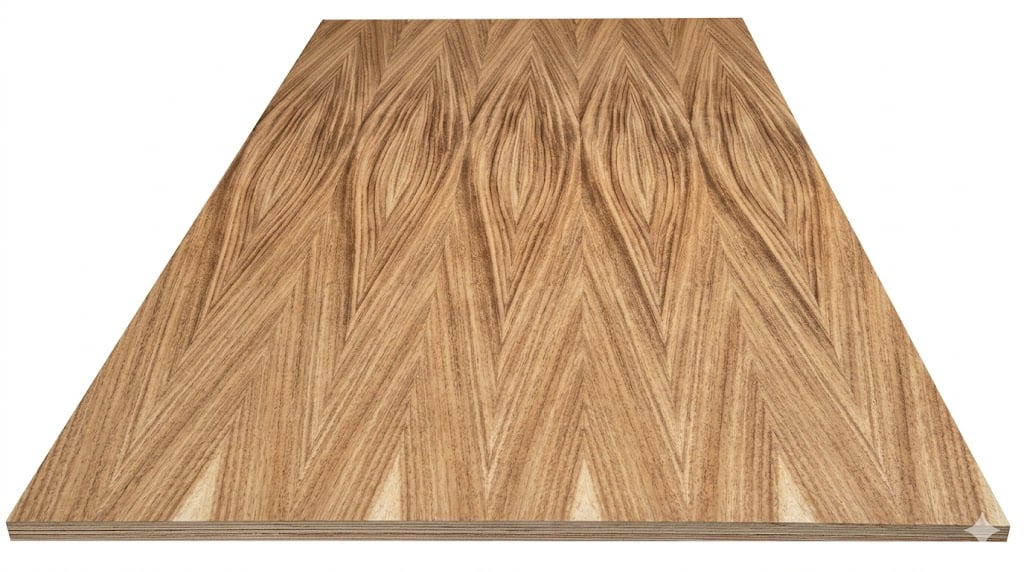
# What Is Parota Plywood? Complete Buyer’s Guide
The global furniture and architectural millwork markets have witnessed a dramatic surge in demand for exotic hardwoods that deliver both visual impact and practical performance. Among these, parota wood has emerged as a standout favorite—captivating designers, furniture manufacturers, and discerning consumers with its dramatic grain patterns, rich golden-brown tones, and organic character that commands attention in any space.
However, sourcing solid parota lumber presents significant challenges: premium pricing that can exceed $15-25 per board foot, limited availability of wide boards, substantial dimensional movement requiring expert handling, and shipping costs that make international trade prohibitively expensive for many applications. For importers, furniture manufacturers, distributors, and millwork companies seeking to capture the aesthetic appeal of this spectacular species while maintaining competitive pricing and production efficiency, **parota plywood** offers a compelling solution.
But what exactly is parota plywood? How does it differ from solid parota lumber? What quality indicators separate premium products from inferior alternatives? Which applications maximize its advantages, and where might other materials be more appropriate? For businesses navigating international sourcing, understanding these distinctions is critical—the difference between profitable product lines and costly mistakes often hinges on technical knowledge that suppliers won’t always volunteer.
This comprehensive buyer’s guide provides the practical information import managers, purchasing agents, furniture manufacturers, and distributors need to evaluate parota plywood confidently. From understanding construction specifications and quality grading to navigating international sourcing and making informed supplier selections, this guide equips you with the technical foundation to make purchasing decisions that align with your business objectives, production requirements, and market positioning.
## Understanding Parota Wood: The Species Behind the Beauty
Before evaluating parota plywood, understanding the wood species itself is essential—its inherent characteristics drive both the opportunities and limitations of engineered products.
### The Parota Tree: Origins and Characteristics
**Botanical Identity:**
– **Scientific name:** Enterolobium cyclocarpum
– **Family:** Fabaceae (legume family)
– **Common names:**
– Parota (Mexico—most common commercial name)
– Guanacaste (Central America—Costa Rica’s national tree)
– Monkey Pod (Hawaii and Pacific regions)
– Rain Tree, Elephant Ear Tree (descriptive names for massive canopy)
– Oreja (Spanish: “ear,” referring to seed pod shape)
**Geographic Distribution:**
– **Native range:** Pacific coast of Mexico south through Central America to northern South America
– **Primary commercial sources:** Mexico (Jalisco, Nayarit, Sinaloa, Colima, Michoacán), Costa Rica, Guatemala, Honduras
– **Plantation cultivation:** Increasingly grown in managed forestry operations in Mexico and Central America
– **Introduced regions:** Hawaii, parts of Asia (ornamental/shade tree use)
**Tree Characteristics:**
– **Size:** Massive trees reaching 25-35 meters (80-115 feet) in height
– **Trunk diameter:** Commonly 1-2 meters; exceptional specimens exceed 3 meters
– **Canopy spread:** Can reach 40-60 meters wide—one of the broadest canopies in tropical forests
– **Growth rate:** Relatively fast-growing for a hardwood (10-15 years to commercial size)
– **Lifespan:** 80-120 years typical; some specimens exceed 200 years
– **Ecological role:** Nitrogen-fixing legume; provides extensive shade; important wildlife habitat
**Why Tree Characteristics Matter for Buyers:**
– Large trunk diameters enable **wide boards and veneers** without glue joints
– Fast growth contributes to **moderate density** (easier machining, lighter weight)
– Broad canopy and irregular growth create **dramatic grain figures** (commercial advantage)
– Sustainable forestry potential due to **reasonable growth rates** (ethical sourcing possible)
### Visual Characteristics: What Makes Parota Distinctive
**Color Palette**
**Heartwood:**
– **Base color:** Medium golden brown with warm reddish undertones
– **Range:** Considerable variation from pale honey gold to deep chocolate brown
– **Variation:** Often dramatic color shifts within single boards—creates visual interest
– **Aging:** Darkens moderately with UV exposure, developing richer tobacco-brown patina
– **Uniformity:** Intentionally inconsistent—natural variation considered desirable character
**Sapwood:**
– **Color:** Pale yellowish-cream to nearly white
– **Contrast:** Sharply demarcated from heartwood
– **Commercial use:** Often excluded from face veneers in premium grades
– **Design opportunity:** Some contemporary designs embrace sapwood for dramatic natural edge aesthetics
**Color Consistency Considerations:**
– **Batch matching:** Color variation between trees significant; order single-batch material for projects requiring consistency
– **Panel-to-panel variation:** Expect noticeable color differences across large orders
– **Design strategy:** Either embrace variation as feature or specify tight color matching (increases cost)
– **Finishing impact:** Natural oils and clear finishes deepen color; darker stains can unify variable material
**Grain Pattern and Figure: Parota’s Signature Asset**
This is where parota truly distinguishes itself in the marketplace:
**Fundamental Grain Characteristics:**
– **Highly interlocked grain** creating three-dimensional visual movement
– **Irregular, wavy patterns** rarely running straight for extended lengths
– **Dramatic swirls, curls, and figure** throughout
– **Alternating light and dark zones** from differential wood density
– **Cathedral patterns** in flat-sawn cuts (arching grain figures)
– **Ribbon stripe figure** in quarter-sawn orientations (less common, premium appearance)
**Special Figure Types (Premium Value):**
**Mineral Streaking:**
– Dark brown to black irregular streaks from mineral deposits
– Adds organic, artistic character
– Highly prized in contemporary design
– Can appear as fine lines or dramatic zones
**Spalting:**
– Dark zone lines from fungal colonization (before decay stage)
– Creates natural artistic patterns resembling pen-and-ink drawings
– Adds unique character—no two pieces identical
– Premium market segment values spalted parota highly
**Crotch Figure:**
– Where trunk divides, grain converges creating feather or flame patterns
– Among most dramatic and valuable figures
– Limited availability (small percentage of tree)
– Commands significant premium pricing
**Burl Figure:**
– Rare in parota but occasionally available
– Highly contorted, eye-filled grain
– Extremely valuable for specialty applications
– Usually available only as veneer (too unstable as solid wood)
**Live Edge Character:**
– Natural edge with bark (removed) and organic contours
– Showcases tree’s natural growth
– Major contemporary design trend
– Particularly popular for dining tables, bar tops, conference tables
**Market Advantage:** Parota’s dramatic, organic grain patterns create instant visual impact—even in thin veneer form, the species looks expensive and exotic without requiring staining or artificial enhancement.
**Texture and Surface Qualities**
– **Texture:** Medium to coarse
– **Pore structure:** Large, open pores clearly visible
– **Natural luster:** Moderate—develops beautiful soft glow with oil finishes
– **Tactile quality:** Warm, pleasant to touch when finished
– **Grain filling:** Open pores benefit from filling for glass-smooth surfaces; unfilled grain creates traditional, organic appearance
### Physical and Mechanical Properties
Understanding technical specifications helps match material to application requirements:
**Density and Weight**
– **Average air-dried density:** 450-550 kg/m³ (28-34 lbs/ft³)
– **Classification:** Medium-light to medium density
– **Comparison:** Similar to Black Walnut (550 kg/m³), lighter than White Oak (760 kg/m³), heavier than Basswood (415 kg/m³)
– **Practical implication:** Moderately lightweight facilitates handling and reduces shipping costs without sacrificing substantial feel
**Janka Hardness**
– **Rating:** 800-900 lbf (3,560-4,000 N)
– **Comparison:** Softer than Red Oak (1,290 lbf) and Hard Maple (1,450 lbf); similar to Black Walnut (1,010 lbf); harder than Pine (690 lbf)
– **Practical implication:** Adequate hardness for furniture and cabinetry; not suitable for high-traffic flooring unless in engineered form with harder wear layer
**Strength Properties**
– **Modulus of Rupture (bending strength):** 65-78 MPa
– **Modulus of Elasticity (stiffness):** 8,500-10,500 MPa
– **Crushing Strength:** 35-42 MPa
**What These Numbers Mean:**
– **Sufficient for furniture frames** with proper joinery and design
– **Adequate for cabinet construction** and cabinetry applications
– **Not recommended for heavy structural spans** or load-bearing beams
– **Suitable for table tops** with appropriate support structure
– **Good for decorative architectural elements** without structural loads
**Dimensional Stability: The Critical Factor**
This characteristic most significantly drives the value proposition of parota **plywood** versus solid lumber:
**Solid Parota Movement:**
– **Volumetric shrinkage:** 7.5-9.5% (moderate to high)
– **Tangential shrinkage:** 5.0-6.5% (moderate to high)
– **Radial shrinkage:** 3.0-4.0% (moderate)
– **T/R Ratio:** 1.5-1.8 (indicates differential movement, higher warping potential)
**Practical Challenges with Solid Parota:**
– Significant seasonal dimensional movement (expands/contracts with humidity changes)
– Wide boards prone to cupping and warping
– Interlocked grain increases twisting tendency
– Requires expert woodworking techniques to manage movement
– Large panels particularly problematic
**Why Plywood Construction Matters:**
The cross-laminated structure of plywood dramatically reduces dimensional movement:
– **90% reduction** in expansion/contraction compared to solid wood
– Wide panels remain flat across seasons
– Predictable, manageable behavior in furniture manufacturing
– **This stability advantage is plywood’s primary value proposition**
**Durability and Resistance**
**Natural Decay Resistance:**
– **Rating:** Moderate (heartwood)
– **Fungal resistance:** Moderate—adequate for interior applications
– **Insect resistance:** Moderate—not naturally termite-resistant like cedar
– **Service life:** Excellent indoors with appropriate finishing; not recommended for exterior exposure
**Practical Application Guidelines:**
– **Interior furniture and millwork:** Excellent, long-lasting performance
– **Kitchen/bathroom cabinetry:** Suitable with proper sealing and finishing
– **Protected covered exterior:** Possible with marine-grade construction and finishing, but not optimal
– **Unprotected exterior or ground contact:** Not recommended
### Working Properties: Why Manufacturers Love Parota
**Machining Characteristics**
**Sawing:**
– Cuts easily with standard carbide-tipped blades
– Moderate dulling effect (reasonable blade life)
– Interlocked grain requires sharp blades for clean cuts
– Minimal cutting resistance
**Planing and Surfacing:**
– Planes to smooth surface with sharp blades
– Interlocked grain can cause tear-out if blades are dull
– Slight angle adjustment (15-20° cutting angle) minimizes tear-out
– Achieves excellent surface quality with proper technique
**Routing and Shaping:**
– Excellent for decorative profiles and moldings
– Holds detail well in carving and engraving
– CNC-compatible with appropriate tooling and feeds/speeds
– Climb-cutting techniques help manage grain direction
**Drilling and Boring:**
– Drills cleanly without excessive splintering
– Pre-drilling recommended near edges to prevent splitting
– Good fastener-holding capacity for moderate-density wood
– Brad point bits provide cleanest holes
**Sanding and Finishing**
**Sanding:**
– Sands readily through progressive grits (80→120→180→220)
– Moderate dust production (good collection system recommended)
– Open grain texture requires attention—can trap dust particles
– Final sanding with 220-320 grit achieves smooth surface
**Grain Filling:**
– **Optional:** Unfilled grain creates organic, traditional appearance
– **Recommended for high-gloss finishes:** Grain filler creates glass-smooth surface
– **Contemporary trend:** Many designers prefer natural open-grain texture
– **Process:** Apply grain filler, let dry, sand flush before final finishing
**Finish Application:**
**Oil Finishes** (Recommended):
– **Tung oil, Danish oil, hard wax oil:** Deeply penetrate, enhance natural color and grain
– **Advantages:** Easy application, repairable, warm appearance, low-sheen contemporary aesthetic
– **Multiple coats:** Build depth and protection (3-5 coats typical)
– **Maintenance:** Periodic reapplication refreshes appearance
**Film-Building Finishes:**
– **Lacquer, polyurethane, conversion varnish:** Provide durable protective surface
– **Advantages:** Excellent protection, suitable for commercial applications
– **Considerations:** Can obscure depth of grain if applied too heavily
– **Gloss levels:** Satin to semi-gloss most popular; high gloss less common for parota’s organic aesthetic
**Water-Based vs. Solvent-Based:**
– **Water-based:** Environmentally friendly, low odor, doesn’t amber over time
– **Solvent-based:** Traditional, deepens color more dramatically, slightly more durable
**Staining:**
– Rarely necessary—natural color highly attractive
– If desired, gel stains work better than liquid (prevents blotching)
– Pre-stain conditioner recommended if using liquid stains
– Darker stains can create dramatic, contemporary appearance
**Gluing and Assembly**
– **PVA (yellow/white glue):** Bonds well for most applications
– **Polyurethane glue:** Excellent for moisture-prone applications
– **Epoxy:** Strongest bond for critical joints
– **Surface preparation:** Light sanding with 120-grit improves adhesion
– **Open time:** Adequate for typical assembly procedures
**Health and Safety Considerations**
**Dust Exposure:**
– **Irritation potential:** Moderate—wood dust considered respiratory irritant
– **Allergic reactions:** Some individuals may experience sensitivity
– **Precautions:** Dust collection and personal protective equipment (mask/respirator) strongly recommended
**No Known Toxic Effects:** Unlike some tropical hardwoods, parota not associated with significant toxicity or severe allergic reactions (but individual sensitivity varies).
## What Is Parota Plywood? Construction and Components
Now that we understand the base wood species, let’s examine how parota plywood is manufactured and what distinguishes quality products.
### Basic Plywood Construction
Plywood is an **engineered wood panel** composed of multiple thin layers (plies or veneers) of wood glued together with adjacent layers having their wood grain rotated 90 degrees to one another.
**Fundamental Structure:**
**Face Veneer** (top surface)
– Parota wood veneer
– Thickness: 0.2mm-0.6mm (varies by quality grade)
– The visible surface showcasing parota’s dramatic grain
**Core Layers** (internal structure)
– Multiple cross-laminated wood veneers
– Species: Poplar, eucalyptus, birch, okoume, mixed hardwoods
– Each layer oriented perpendicular to adjacent layers
– Number of plies: 5, 7, 9, 11, or 13 (always odd number for balanced construction)
**Back Veneer** (reverse surface)
– Balancing veneer (often parota for premium grades, commercial species for economy grades)
– Prevents warping by balancing moisture forces
**Adhesive** (binds layers)
– Type: Urea-formaldehyde (E0/E1/E2), phenolic (WBP), or soy-based (eco-friendly)
– Applied between each layer under heat and pressure
**The Cross-Lamination Principle:**
By orienting each layer perpendicular to its neighbors:
– **Dimensional stability dramatically improved** (expansion in one layer constrained by perpendicular layer)
– **Strength enhanced in multiple directions** (no single weak direction like solid wood)
– **Warping and twisting minimized** (balanced construction)
– **Larger panel sizes practical** (solid wood panels over 600mm wide prone to movement problems)
**This engineered structure is why plywood can deliver large, stable panels at a fraction of solid wood’s cost while showcasing premium parota appearance.**
### Parota Face Veneer: The Critical Quality Component
The face veneer is the visible parota surface—its quality directly determines aesthetic appeal and long-term performance.
**Veneer Production Methods**
**1. Rotary Cutting (Most Common)**
**Process:**
– Log mounted on lathe and rotated against stationary blade
– Produces continuous sheet “peeled” from log like unwinding paper towel roll
– Veneer thickness typically 0.3-0.5mm
**Appearance Characteristics:**
– **Wide, varied grain patterns** with dramatic cathedral figures
– **More random, wild appearance** (showcases parota’s natural character)
– **Less formal, more organic aesthetic**
– **Color
Comments