
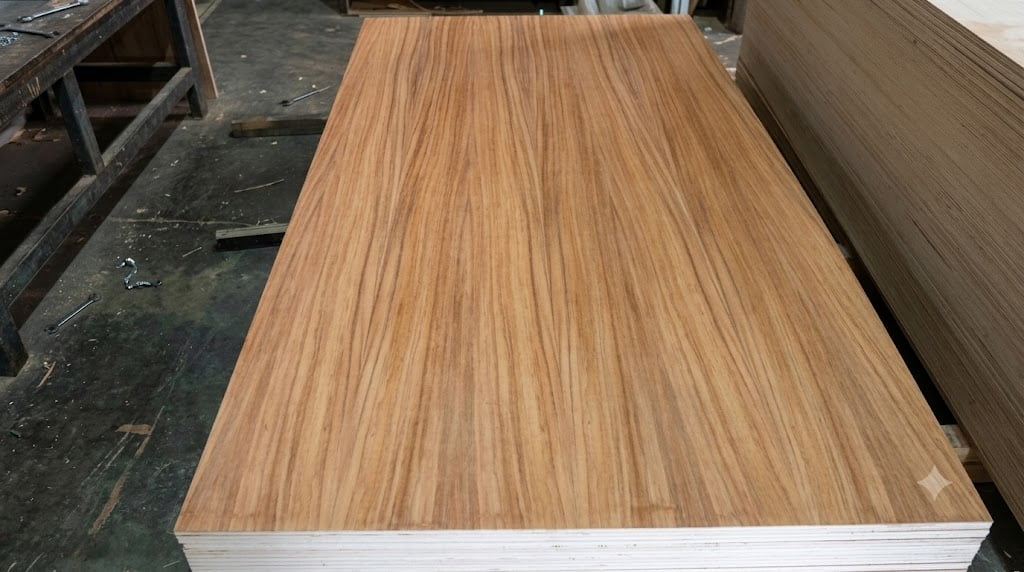
# What Is Parota MDF? Complete Technical and Buyer’s Guide
In the competitive landscape of modern furniture manufacturing and architectural millwork, product developers face a perpetual challenge: how to deliver the visual impact of premium exotic hardwoods while maintaining the precision, consistency, and cost efficiency that contemporary production demands. For businesses working with parota wood—the stunning “Mexican Walnut” prized for its dramatic grain patterns and rich golden-brown tones—this challenge becomes particularly acute.
Solid parota lumber commands premium pricing ($15-25+ per board foot), exhibits significant dimensional movement requiring expert handling, and presents availability constraints for wide boards. Traditional parota plywood, while solving many stability issues, still shows visible ply lines at edges and offers limited precision for highly detailed work. Enter **parota MDF**—an engineered panel product combining parota’s spectacular appearance with MDF’s exceptional flatness, edge precision, and machining consistency.
But what exactly is parota MDF? How does its Medium-Density Fiberboard core fundamentally differ from plywood construction? What specific applications maximize its advantages, and where might alternative materials perform better? For importers, furniture manufacturers, cabinet makers, and millwork specialists evaluating material options, understanding these distinctions is critical—the difference between streamlined production and frustrating material limitations often hinges on matching the right substrate to your specific manufacturing processes and end-use requirements.
This comprehensive guide provides the technical knowledge and practical insights purchasing managers, production planners, and business owners need to evaluate parota MDF intelligently. From understanding core material properties and quality specifications to identifying ideal applications and navigating international sourcing, this guide equips you with the foundation to make informed decisions that align with your production capabilities, market positioning, and profitability objectives.
## Understanding MDF: The Core Material Foundation
Before examining parota-faced MDF specifically, understanding the Medium-Density Fiberboard core material is essential—its unique characteristics drive both the opportunities and limitations of the finished product.
### What Is MDF? Material Composition and Manufacturing
**MDF Definition:**
Medium-Density Fiberboard is an **engineered wood composite** manufactured by breaking down hardwood or softwood residuals into wood fibers, combining those fibers with wax and resin binder, and forming panels under high temperature and pressure.
**Manufacturing Process Overview:**
**1. Raw Material Preparation**
– **Wood source:** Typically softwood (pine, fir) or hardwood (poplar, eucalyptus) chips, sawmill residuals, or plantation wood
– **Debarking:** Logs or wood residuals stripped of bark
– **Chipping:** Wood reduced to uniform chips (20-30mm size)
– **Quality check:** Metal detection and contaminant removal
**2. Defibration**
– **Refining:** Wood chips fed into refiners (large rotating discs) that mechanically separate wood into individual fibers
– **Steam injection:** High-pressure steam (170-180°C) softens lignin, facilitating fiber separation
– **Result:** Fine wood fibers resembling coarse sawdust but with longer individual fiber length
**3. Fiber Drying and Blending**
– **Drying:** Fibers dried to 8-12% moisture content in rotary dryers
– **Resin application:** Urea-formaldehyde resin (typically 8-12% by weight) sprayed onto fibers in rotating drum blenders
– **Wax addition:** Paraffin wax (0.5-1.0%) added for moisture resistance
– **Thorough mixing:** Ensures even resin distribution on fiber surfaces
**4. Mat Formation**
– **Air-laying:** Resin-coated fibers blown onto forming belt, creating uniform mat
– **Pre-compression:** Light compression to consolidate mat before main pressing
– **Density profiling:** Adjust fiber distribution for consistent panel properties
**5. Hot Pressing**
– **Pressure:** 30-45 kg/cm² applied to mat
– **Temperature:** 180-220°C
– **Time:** 20-40 seconds per mm of thickness
– **Chemical reaction:** Heat activates resin curing (polymerization), bonding fibers permanently
– **Result:** Solid, rigid panel
**6. Finishing**
– **Cooling:** Panels stabilized at room temperature
– **Sanding:** Both faces sanded to precise thickness and smoothness (typically 150-180 grit equivalent)
– **Trimming:** Edges cut to exact dimensions
– **Quality inspection:** Density, thickness tolerance, surface quality checked
**7. Veneer Application (for Parota MDF)**
– **Adhesive application:** Urea-formaldehyde glue spread on MDF core surface
– **Veneer layup:** Parota veneer positioned on adhesive
– **Cold or hot pressing:** Pressure applied to bond veneer to core
– **Trimming and sanding:** Edges trimmed, surface lightly sanded if needed
**Key Manufacturing Principle:** Unlike plywood (which maintains wood’s natural layered structure), MDF completely breaks down wood into fibers and reconstitutes it into a homogeneous material—this fundamental difference drives MDF’s unique performance characteristics.
### MDF Physical and Mechanical Properties
Understanding core material properties is essential for predicting finished panel performance:
**Density Classification and Specifications**
MDF is categorized by density, with **medium-density** representing the standard furniture-grade material:
**Standard MDF (Medium-Density):**
– **Density range:** 600-800 kg/m³ (typical: 720-750 kg/m³)
– **Weight:** 18mm panel ≈ 14-16 kg/m² (significantly heavier than plywood)
– **Applications:** Furniture, cabinetry, millwork—most parota MDF uses this grade
**High-Density MDF (HDF):**
– **Density:** 800-1,000+ kg/m³
– **Applications:** Flooring underlayment, specialized applications requiring extreme hardness
– **Characteristics:** Very hard surface, excellent for high-detail machining, even heavier than standard MDF
**Light-Density MDF (LDF):**
– **Density:** 450-600 kg/m³
– **Applications:** Non-structural applications, backing panels, drawer bottoms
– **Characteristics:** Lighter weight, lower strength, rarely used for visible furniture components
**For parota-faced panels, standard medium-density MDF (720-750 kg/m³) represents the overwhelming majority of commercial products.**
**Structural Strength: Understanding Limitations**
**Bending Strength (Modulus of Rupture):**
– **Typical value:** 22-30 MPa (18mm standard MDF)
– **Comparison:** Approximately **40-50% of plywood** strength (plywood: 45-60 MPa)
– **Practical implication:** Adequate for most furniture applications but requires design consideration for spanning or load-bearing uses
**Modulus of Elasticity (Stiffness):**
– **Typical value:** 2,200-2,800 MPa
– **Comparison:** Roughly **30-40% of plywood** stiffness (plywood: 6,000-8,000 MPa)
– **Practical implication:** More prone to sagging under load; shelving spans should be limited or reinforced
**Internal Bond Strength:**
– **Typical value:** 0.50-0.70 MPa
– **Indication:** Measures how well fibers bonded together
– **Quality marker:** Higher values indicate better manufacturing quality and screw-holding capacity
**What These Numbers Mean for Applications:**
✅ **Suitable for:**
– Cabinet doors (properly hung, not spanning significant distance)
– Drawer fronts (structural support from drawer box)
– Decorative panels (non-load-bearing)
– Wall paneling and wainscoting
– Furniture components with frame support
⚠️ **Requires consideration for:**
– Shelving (limit spans to 600mm/24″ or provide center support)
– Table tops (use thicker material, 25-30mm, or add frame/apron support)
– Large unsupported panels (may sag over time under own weight)
❌ **Not recommended for:**
– Long spans without support (will deflect/sag)
– High-impact applications (edges chip more easily than plywood)
– Structural framing or load-bearing components
**Dimensional Stability: MDF’s Defining Advantage**
This is where MDF truly excels and differentiates itself from solid wood and, in some respects, plywood:
**Isotropy (Uniform Properties):**
– **No grain direction** (fibers oriented randomly in all directions)
– **Equal expansion/contraction** in length and width (unlike wood’s differential movement)
– **No warping from grain tension** (no internal stress from wood grain)
– **Perfectly flat** out of production (no natural curvature or wind)
**Dimensional Movement:**
– **Thickness swelling:** 8-15% when fully saturated (primary movement direction)
– **Linear expansion:** 0.25-0.35% per 1% moisture content change
– **Comparison to plywood:** Similar linear stability; **superior flatness** (no grain-related warping)
– **Comparison to solid parota:** **80-90% more stable** (massive advantage)
**Practical Advantages:**
✅ **Perfect substrate for veneer:**
– Extremely flat surface prevents veneer telegraphing (showing substrate irregularities)
– No grain pattern from core bleeding through thin veneers
– Veneer adheres uniformly across entire surface
– Result: Parota figure displays perfectly without distortion
✅ **Precision manufacturing:**
– Panels remain flat during machining operations
– CNC routing produces exact, repeatable dimensions
– Multiple pieces cut from same sheet are truly identical
– Critical for mass production and component interchangeability
✅ **Consistent panel-to-panel:**
– Every sheet in production run has identical properties
– No variation from wood grain, knots, or density differences
– Simplifies production planning and quality control
✅ **Large format stability:**
– Full 1220x2440mm (4’x8′) sheets remain flat
– Can produce even larger panels (2500x1830mm+) without warping concerns
– Enables expansive wall panels, large doors, oversized components
**Moisture Behavior: Critical Limitation**
Despite excellent dimensional stability in controlled conditions, MDF has a significant vulnerability:
⚠️ **Standard MDF Moisture Sensitivity:**
**Absorption:**
– MDF absorbs moisture readily when exposed
– Individual wood fibers swell when wet
– **Thickness swelling** is primary problem (can increase 10-15% when saturated)
– **Edge exposure** especially vulnerable (unfinished edges absorb moisture rapidly)
**Consequences of Moisture Exposure:**
– Surface texture roughens (fibers swell and “fuzz”)
– Edges swell and distort
– Once swollen, MDF does **not return** to original dimensions when dried
– **Permanent damage** from moisture exposure—unlike solid wood or plywood which can recover
**Practical Implications:**
❌ **Unsuitable for:**
– Exterior applications (even covered)
– Bathroom vanities (high humidity, splash exposure)
– Kitchen base cabinets near sinks (risk of water exposure)
– Unfinished exposed edges in any moisture-prone area
✅ **Moisture-Resistant MDF (MR-MDF) Available:**
– **Modified resin system** (higher resin content, moisture-resistant additives)
– **Green core color** (typically dyed green for identification)
– **Improved performance:** Reduces thickness swelling to 6-8% (vs. 10-15% standard)
– **Still not waterproof:** Suitable for bathrooms/kitchens with proper finishing, not exterior use
– **Cost premium:** 15-25% higher than standard MDF
🔧 **Protection Strategies:**
– Seal all edges with edge banding, paint, or sealant before installation
– Apply finish to all surfaces (face and back) for balanced moisture protection
– Avoid placement in direct water exposure zones
– Use coasters, protective pads under planters or liquids
**Screw-Holding Capacity: Mixed Performance**
**Face Screwing (into panel surface):**
– **Holding power:** 1,000-1,400 N (moderate—adequate for most furniture assembly)
– **Performance:** Good for attaching hardware, brackets, drawer slides
– **Technique:** Pilot holes recommended (prevents fiber crushing, improves holding)
– **Comparison:** 70-80% of plywood face screw-holding
**Edge Screwing (into panel edge):**
– **Holding power:** 400-700 N (weak—significantly less than plywood)
– **Problem:** Screws compress rather than grip fibers, leading to pull-out
– **Recommendation:** Avoid critical structural connections relying on edge screws
– **Alternatives:** Use confirmat screws, barrel nuts, or dedicated MDF fasteners for critical joints
**Improvement Strategies:**
– **Pilot holes:** Slightly smaller than screw shaft diameter reduces fiber compression
– **MDF-specific screws:** Coarser threads, special designs improve holding
– **Glue reinforcement:** Apply wood glue in conjunction with screws
– **Inserts and hardware:** Threaded inserts, barrel nuts provide reliable hardware attachment in edges
**Machining Properties: Precision and Consistency**
This is where MDF demonstrates exceptional performance that drives its adoption in high-volume manufacturing:
**Cutting and Sawing:**
✅ **Advantages:**
– **Perfectly clean cuts** with carbide-tipped blades (no tear-out or grain-related chipping)
– **Consistent cutting resistance** (no hard/soft spots from wood grain)
– **Precise, repeatable dimensions** (critical for mass production)
– **No blade deflection** from grain direction changes
⚠️ **Considerations:**
– **Aggressive blade dulling** (abrasive resin content wears cutting edges)
– **Carbide tooling required** (high-speed steel dulls too rapidly)
– **Heavy dust generation** (fine, powder-like dust requires excellent collection)
– **Regular blade changes** necessary for quality cuts in production environment
**Routing and Profiling:**
✅ **Exceptional Performance:**
– **Holds extremely fine detail** (profiles, moldings, decorative routing)
– **No tear-out** regardless of routing direction (no grain to tear)
– **Clean, crisp edges** on decorative profiles
– **Identical results** across all panels (no grain variation affecting cut quality)
– **CNC excellence:** Ideal for intricate computer-controlled routing, engraving, 3D carving
**Applications Leveraging Routing Precision:**
– Intricate door panel profiles
– Decorative moldings and trim
– 3D textured wall panels
– Engraved designs and patterns
– Complex furniture component shapes
**Edge Quality:**
✅ **Significant Advantage:**
– **Smooth, uniform edge** after cutting (no visible layers like plywood)
– **Takes paint beautifully** (creates seamless painted finish)
– **Edge banding adheres uniformly** (PVC, veneer, acrylic bands bond perfectly)
– **Can be shaped and profiled** for decorative edge treatments
This edge quality is a **major reason parota MDF is specified** for applications where painted or banded edges are desired—no visible substrate layers to telegraph through finish.
**Sanding:**
✅ **Advantages:**
– **Sands to extremely smooth surface** (finer than solid wood or plywood)
– **Consistent sanding behavior** (no hard grain lines or soft areas)
– **Excellent base for veneer** (perfectly smooth substrate)
⚠️ **Considerations:**
– **Very fine dust** (respirator strongly recommended)
– **Dust management critical** (fire hazard if dust accumulates on equipment)
– **Clogs sandpaper more quickly** than solid wood (resin content)
**Dust and Health Considerations:**
⚠️ **Important Safety Notes:**
**Dust Characteristics:**
– Extremely fine particles (respirable size range)
– High dust volume generation during cutting/sanding
– Resin content in dust (formaldehyde exposure concern)
**Health Precautions:**
– **Dust collection mandatory** (not optional—both safety and quality requirement)
– **Respirator use required** when machining (N95 minimum; P100 preferred)
– **Adequate ventilation** essential in production areas
– **Regular cleanup** prevents dust accumulation (fire/explosion hazard)
– **Formaldehyde exposure:** Use E0 or E1 grade MDF; ensure adequate ventilation
### MDF Grade Classifications and Standards
Understanding quality standards helps specify appropriate materials:
**Emission Standards (Formaldehyde Content):**
The urea-formaldehyde resin used in MDF manufacturing releases formaldehyde gas—emission standards regulate acceptable levels:
**E0 Standard** (Highest Quality):
– **Formaldehyde emission:** ≤ 0.5 mg/L
– **Equivalency:** Approaching natural wood emission levels
– **Applications:** Premium furniture, children’s furniture, health-conscious markets
– **Cost premium:** +15-25% over E1
**E1 Standard** (Industry Standard):
– **
Comments