
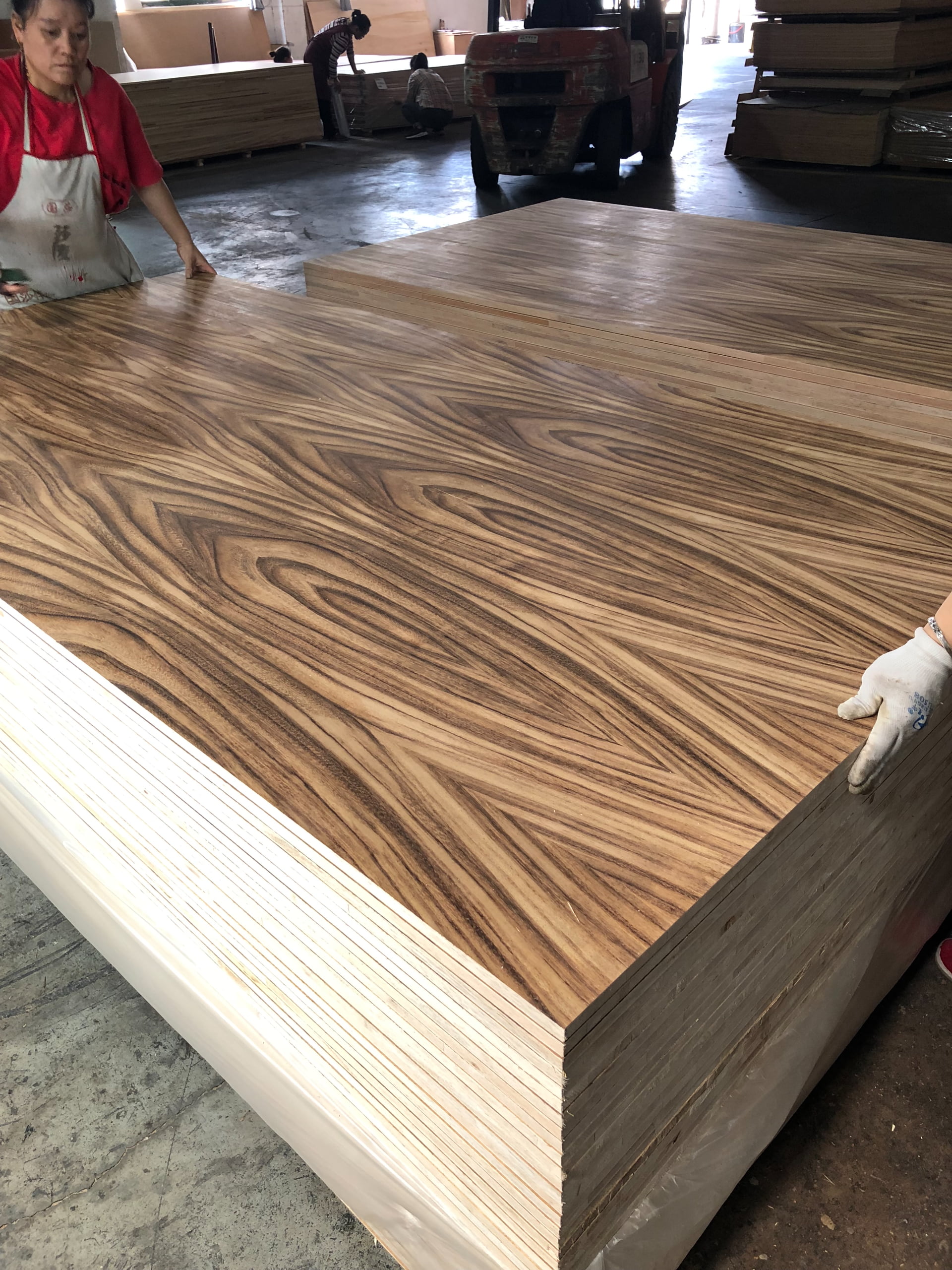
What Is Parota Block Board?
Parota block board represents a specialized category of engineered wood panel combining a solid wood strip core with cross-banded veneer layers and natural parota wood face veneers to create lightweight, dimensionally stable panels particularly valued for door manufacturing, cabinet construction, and architectural millwork applications. As a professional parota block board manufacturer and supplier serving furniture factories, door manufacturers, cabinet makers, and building material distributors across global markets, we understand that block board’s unique construction delivers specific performance characteristics—exceptional screw-holding capacity, superior dimensional stability compared to solid wood, and reduced weight versus standard plywood—that make it the optimal choice for applications requiring structural integrity combined with exotic parota wood aesthetics. Whether specified for interior doors, cabinet backs and sides, furniture frames, or architectural wall panels, parota block board delivers the exotic golden-brown appearance and distinctive grain patterns of natural parota wood while providing the engineered performance advantages essential for commercial manufacturing efficiency and long-term product durability.
This comprehensive guide provides furniture manufacturers, door producers, and wood product buyers with detailed technical information on parota block board construction, core material options, specification standards, and application-specific selection criteria necessary for informed procurement decisions. From understanding how solid wood strip cores differ fundamentally from plywood’s thin-ply construction to evaluating quality factors influencing performance and comparing block board advantages against alternative panel types, this resource addresses the critical factors determining successful parota block board specification for commercial production applications.
- Parota Block Board Definition and Construction
- How Parota Block Board Is Manufactured
- Parota Block Board Specifications: Thickness, Sizes and Grades
- Parota Block Board Core Materials: Softwood vs Hardwood
- Advantages of Parota Block Board for Furniture and Doors
- Disadvantages and Limitations of Block Board
- Parota Block Board vs Plywood: Key Differences
- Common Applications of Parota Block Board
- How to Identify Quality Parota Block Board
- Parota Block Board Pricing Factors
- Buying Guide: Selecting Parota Block Board for Your Project
- Frequently Asked Questions
Parota Block Board Definition and Construction
Block board is an engineered wood panel product characterized by a core constructed from solid wood strips—typically 25mm to 30mm wide—glued edge-to-edge and sandwiched between cross-banded veneer layers and face veneer sheets to create a composite panel combining solid wood’s structural properties with engineered panel’s dimensional stability. Parota block board specifically refers to block board panels finished with natural parota wood face veneers, transforming standard block board’s utilitarian construction into a premium architectural surface exhibiting parota’s distinctive golden-brown coloration and exotic grain patterns. This construction method positions block board between solid wood panels and conventional plywood—heavier and more robust than plywood’s thin-ply laminate structure, yet lighter and more stable than solid wood panels of equivalent thickness—creating a unique performance profile particularly suited to applications requiring substantial screw-holding capacity, reduced weight, and minimal warping under varying humidity conditions.

The term “block board” derives from the panel’s distinctive core construction where individual wood strips or “blocks” are assembled parallel to one another and glued together to form a continuous core layer. Unlike plywood where the core consists of multiple thin veneer plies (typically 1.5mm-3mm thickness) oriented in alternating grain directions, block board’s core comprises much thicker solid wood strips oriented with grain running in the same direction. This fundamental construction difference creates block board’s characteristic performance advantages: the solid wood core provides excellent dimensional stability in the core grain direction, superior screw and nail holding capacity compared to plywood or MDF, and reduced overall panel weight versus equivalent-thickness plywood due to the core’s lower density softwood composition.
Parota block board specifically targets premium furniture, architectural millwork, and interior door applications where the exotic appearance of parota wood enhances product aesthetics while block board’s engineered construction delivers manufacturing advantages and performance characteristics superior to solid parota panels. By combining parota’s visual appeal—warm golden to chocolate-brown heartwood color, dramatic grain contrast, and natural character including mineral streaking and irregular grain patterns—with block board’s structural efficiency and dimensional stability, manufacturers produce products delivering luxury material aesthetics at commercial production scale and competitive pricing relative to solid exotic hardwood alternatives.
Understanding Block Board Core Structure
The core layer represents block board’s defining structural component and determines many of the panel’s key performance characteristics including weight, strength properties, screw-holding capacity, and dimensional stability:
Core Strip Dimensions: Block board core strips typically measure 25mm to 30mm in width (across the grain), though standards vary by manufacturing region and panel grade. Individual strips extend the full length or width of the panel depending on grain orientation specified—most commonly, core strips run parallel to the panel’s length dimension (the 2440mm direction in standard 1220mm x 2440mm panels) to maximize bending strength in the primary span direction for door and panel applications. Strip thickness equals the panel’s finished core thickness, which varies based on overall panel specification—for example, an 18mm finished block board might feature a 12mm core thickness after accounting for cross bands and face veneers.
Core Assembly Method: Individual wood strips are edge-glued together under pressure to form a continuous core panel with minimal gaps between adjacent strips. Quality block board manufacturing requires careful strip selection for uniform thickness, straight grain orientation, and defect-free material to ensure gap-free core assembly and consistent panel thickness. High-grade block board features tightly jointed cores with gaps under 2mm between strips, while lower grades may exhibit wider gaps that can telegraph through thin face veneers or create weak points affecting structural performance. Premium manufacturers employ finger-jointing techniques to create longer core strips from shorter sections, reducing waste while maintaining core integrity throughout the panel.
Core Wood Species: Block board cores are typically constructed from softwood species (pine, fir, poplar) chosen for their light weight, availability, and cost-effectiveness, though hardwood cores (eucalyptus, mixed hardwood) or combination cores (hardwood outer strips + softwood center strips) are specified for applications requiring enhanced strength or screw-holding in critical edge areas. The core species significantly influences panel characteristics—softwood cores minimize weight (advantageous for doors and wall panels), while hardwood cores improve edge screw retention (critical for cabinet hinge mounting and door hardware installation). Core moisture content at manufacture typically ranges from 8-12% to match equilibrium moisture content in typical interior environments and minimize dimensional change after installation.
Grain Orientation: Core strip grain orientation runs parallel to strip length, meaning the entire core features uniform grain direction—a fundamental difference from plywood’s alternating grain direction between plies. This uniform grain orientation provides excellent dimensional stability and strength in the core grain direction while creating slightly less stability perpendicular to grain compared to plywood’s cross-grain construction. The cross-banded veneer layers applied to both core faces compensate for this directional characteristic, restraining cross-grain movement and creating balanced panel construction suitable for most architectural and furniture applications.
Parota Veneer Face Layers
The face veneer layers transform utilitarian block board core construction into premium architectural surfaces exhibiting parota wood’s exotic beauty and natural character:
Face Veneer Characteristics: Parota face veneers applied to block board panels typically range from 0.6mm to 1.5mm thickness depending on panel grade and application requirements. Thinner veneers (0.6mm-0.8mm) reduce material cost and are suitable for paint-grade applications or projects where pronounced grain texture is not critical. Thicker veneers (1.0mm-1.5mm) provide deeper, more authentic solid wood appearance with pronounced grain texture, better resistance to sanding-through during finishing, and improved durability
Comments