
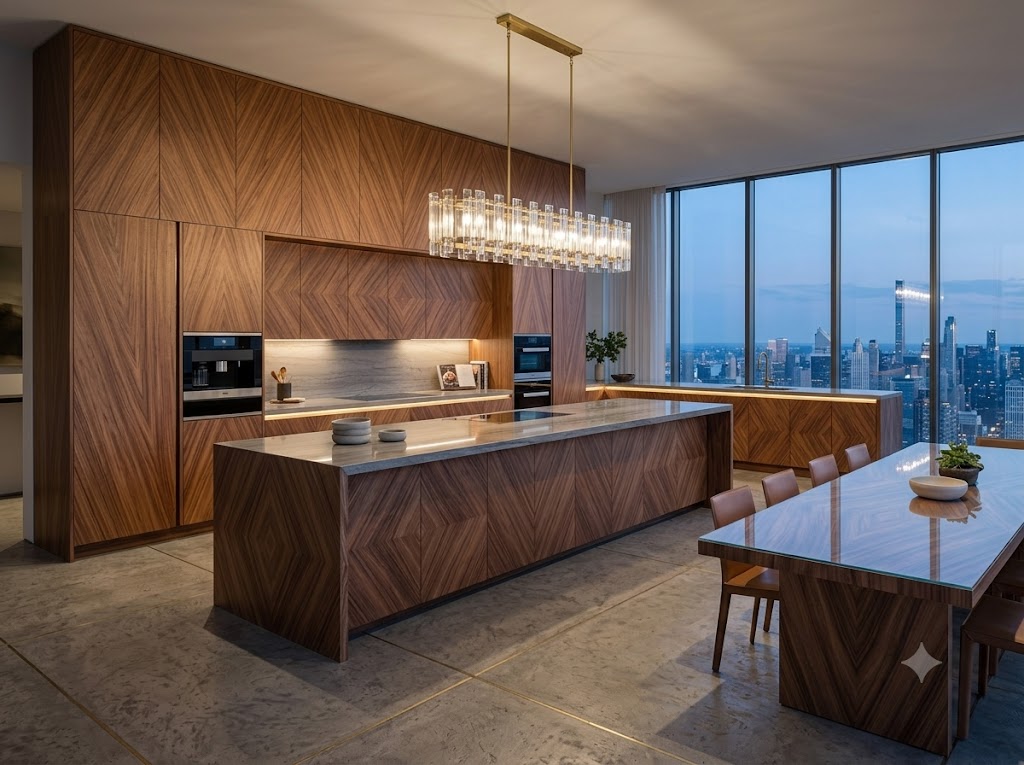
# Parota Plywood For Kitchen Cabinets: Complete Technical Guide for Manufacturers and Designers
Kitchen cabinet production represents one of the most demanding applications in furniture manufacturing—a complex intersection of structural engineering, moisture management, dimensional precision, aesthetic appeal, production efficiency, and cost optimization. Cabinet manufacturers face relentless pressure: homeowners demand beautiful, durable cabinetry at competitive prices; designers require dimensional stability that maintains precise reveals and alignments; installers need consistent, predictable materials; and the manufacturing operation itself must balance material costs, labor efficiency, and quality standards while meeting aggressive delivery timelines.
In this challenging environment, material selection fundamentally determines project success. The choice between solid hardwood, various plywood species, MDF, particleboard composites, and hybrid constructions directly impacts production costs, manufacturing efficiency, structural performance, aesthetic differentiation, and ultimately, customer satisfaction and profitability. While solid hardwood construction delivers undeniable premium appeal and tactile quality, the dimensional movement inherent in solid wood creates ongoing engineering challenges—seasonal door binding, drawer misalignment, joint failures, and finish cracking plague even experienced cabinet shops, generating warranty callbacks and customer dissatisfaction that erode profitability and reputation.
For kitchen cabinet manufacturers seeking materials that deliver premium hardwood aesthetics—distinctive grain patterns, warm natural coloration, and authentic wood character—while simultaneously providing the dimensional stability, large panel format efficiency, and cost-performance advantages essential for profitable production, **parota plywood** presents a compelling solution that addresses these competing demands effectively. This Mexican and Central American hardwood, processed into engineered plywood panels, combines visual warmth and organic beauty with the structural predictability and economic efficiency that modern cabinet production requires.
Yet despite parota plywood’s growing adoption in high-end residential, hospitality, and commercial kitchen projects—particularly in Mexico, southwestern United States, and increasingly throughout North America—comprehensive technical guidance specifically addressing **kitchen cabinet applications** remains fragmented. Cabinet manufacturers, designers, and specifiers evaluating the material need answers to critical application-specific questions: How does parota plywood perform in humid kitchen environments compared to traditional cabinet species? What thickness specifications, core constructions, and adhesive types optimize performance in various cabinet components? Which construction methods, joinery techniques, and edge treatments deliver both structural integrity and aesthetic appeal? How should finishing systems be specified to balance beauty with the durability demands of kitchen service? What are realistic cost implications across material procurement, manufacturing processes, and installed performance?
This definitive technical guide addresses these questions systematically, providing the detailed specifications, construction recommendations, performance analysis, and practical manufacturing insights that enable informed decision-making. From understanding material characteristics and specifying appropriate grades to detailing construction methods and troubleshooting common challenges, this comprehensive resource equips cabinet manufacturers, kitchen designers, production managers, and purchasing professionals with the technical foundation to successfully specify, source, and manufacture kitchen cabinets using parota plywood—maximizing quality, efficiency, and profitability while delivering distinctive products that differentiate their offerings in competitive markets.
—
## Why Parota Plywood for Kitchen Cabinets: Strategic Advantages
Before examining detailed specifications and construction methods, understanding the fundamental advantages parota plywood brings to kitchen cabinet applications establishes the strategic rationale for material selection.
### Dimensional Stability: The Primary Performance Advantage
**The Kitchen Environment Challenge:**
Kitchens present one of the most demanding moisture environments in residential construction:
– **Humidity fluctuations:** Cooking, dishwashing, and cleaning create dramatic humidity spikes
– **Seasonal variation:** Heating systems (winter) and air conditioning (summer) create extreme dryness-to-humidity cycles
– **Temperature changes:** Heat from cooking appliances creates localized temperature gradients
– **Long-term exposure:** Unlike living areas with moderate conditions, kitchens experience environmental extremes daily
**Solid Wood Performance Limitations:**
Traditional solid wood cabinet construction faces inherent challenges in kitchen environments:
**Seasonal Movement:**
– **Expansion:** Wood absorbs moisture and expands across grain (width direction)
– **Contraction:** Wood releases moisture and contracts in dry conditions
– **Movement magnitude:** Hardwoods typically move **8-10% across grain** from wet-to-dry extremes
– **Example:** 300mm (12″) wide solid wood panel can expand/contract 3-4mm (1/8″-5/32″)—enough to cause significant functional problems
**Resulting Problems:**
– ❌ **Door binding:** Doors that fit properly in winter stick in summer (or vice versa)
– ❌ **Reveal inconsistency:** Gaps around inset doors vary seasonally
– ❌ **Drawer misalignment:** Drawer fronts shift relative to openings
– ❌ **Joint failure:** Frame-and-panel joints stressed by movement; glue lines fail
– ❌ **Finish damage:** Finishes crack as wood moves beneath them
– ❌ **Warranty issues:** Callbacks for seasonal adjustment, repair
**Parota Plywood Solution:**
Plywood’s cross-laminated construction fundamentally solves dimensional movement problems:
**How Cross-Lamination Works:**
– **Alternating grain direction:** Each ply oriented 90° to adjacent plies
– **Mutual restriction:** Grain in each ply restricts movement of adjacent plies
– **Balanced construction:** Face veneers on both surfaces create symmetrical structure preventing warping
**Quantified Performance:**
– **Movement reduction:** Plywood moves approximately **1/5 to 1/3** of equivalent solid wood
– **Example:** 300mm wide plywood panel moves only 0.6-1.2mm (1/32″-1/16″) under same conditions causing 3-4mm movement in solid wood
– **Practical significance:** Movement magnitude reduced below threshold that causes functional problems
**Cabinet Performance Benefits:**
✅ **Year-round functionality:**
– Doors operate smoothly regardless of season
– Reveals remain consistent
– Drawers maintain proper alignment
– Hardware stays properly positioned
✅ **Reduced callbacks:**
– Eliminate seasonal adjustment visits
– No warping-related complaints
– Fewer finish failure issues
– Lower warranty costs
✅ **Installation reliability:**
– Cabinets can be installed immediately (no “acclimation period” concerns)
– Precise factory dimensions maintained in field
– Predictable performance across climate zones
✅ **Long-term durability:**
– Joints remain tight over decades
– Minimal long-term deformation
– Finishes remain intact
### Aesthetic Appeal: Premium Hardwood Character
While dimensional stability provides functional advantages, **aesthetic differentiation** drives market positioning and premium pricing.
**Parota’s Distinctive Visual Character:**
**Color Properties:**
– **Base tone:** Warm golden brown to medium tobacco brown
– **Variation:** Natural color variation within and between boards creates visual interest
– **Undertones:** Golden, honey, caramel—psychologically associated with warmth and comfort
– **Aging:** Darkens and enriches over time, developing attractive patina
**Design Psychology:**
– **Warmth and welcoming:** Golden-brown tones create inviting kitchen atmosphere
– **Natural authenticity:** Obvious real wood (not laminate or synthetic)
– **Organic character:** Visible grain patterns, color variation communicate craftsmanship
– **Tropical luxury:** Association with resort environments, upscale hospitality
**Grain Pattern Characteristics:**
**Natural Figure:**
– **Interlocked grain:** Creates three-dimensional visual depth
– **Swirling patterns:** Dramatic organic patterns where grain shifts direction
– **Cathedral figures:** Classic arched patterns on flat-sawn faces
– **Unique character:** No two panels identical—each kitchen one-of-a-kind
**Movement and Depth:**
– **Chatoyance:** Surface appearance changes with viewing angle as light reflects off alternating grain
– **Dynamic surfaces:** Cabinets appear to have motion, life (vs. static appearance of plain materials)
– **Visual richness:** Provides decorative interest without applied ornamentation
**Market Differentiation:**
**Competitive Positioning:**
**vs. Standard Cabinet Species:**
– **Oak:** Parota less red-toned; finer, more refined grain; more contemporary appeal
– **Maple:** Parota significantly more grain character; warmer color; more distinctive
– **Birch:** Parota more dramatic figure; richer color; premium positioning
– **Cherry:** Similar warmth; parota more affordable; different grain character
**vs. Exotic/Premium Species:**
– **Walnut:** Parota lighter color; different character; **significantly lower cost** (30-50% less)
– **Teak:** Similar tropical aesthetic; parota more sustainable/affordable; comparable performance
– **Mahogany:** Similar warmth; parota more sustainable; different grain structure
**Design Versatility:**
✅ **Transitional designs:** Bridges traditional warmth with contemporary clean lines
✅ **Modern rustic:** Perfect for popular farmhouse-modern aesthetic
✅ **Coastal contemporary:** Warm tones complement beachy, relaxed environments
✅ **Southwestern/Spanish:** Natural choice for regional architectural styles
✅ **Tropical/resort:** Authentic tropical hardwood for vacation-inspired kitchens
✅ **Scandinavian influence:** Warm wood tones balance Nordic simplicity
**Color Coordination:**
**Complements:**
– **Countertops:** Works with granite, quartz, marble, concrete, butcher block
– **Backsplash:** Coordinates with tile, stone, glass, metal
– **Flooring:** Harmonizes with wide range of wood, tile, stone flooring
– **Wall colors:** Neutral enough to work with whites, grays, earth tones, even bold accent colors
### Cost-Performance Advantages: Economic Efficiency
Kitchen cabinet manufacturing operates on tight margins—material cost-performance ratios directly impact profitability.
**Material Cost Comparison:**
**Parota Plywood vs. Solid Parota:**
– **Price differential:** Plywood typically **30-50% less expensive** per square foot than solid lumber
– **Yield efficiency:** Plywood 100% usable; solid lumber 40-60% waste after milling
– **Sizing:** Plywood eliminates need for edge-gluing wide panels (labor + adhesive cost)
**Example Calculation (Per Cabinet):**
“`
Typical Base Cabinet (915mm × 610mm × 865mm / 36″ × 24″ × 34″):
Solid Wood Construction:
– Material required (with waste): 3.5 m² at $45/m² = $157.50
– Edge-gluing labor: 1.5 hours at $25/hr = $37.50
– Adhesive: $5.00
– TOTAL: $200.00
Plywood Construction:
– Material required: 2.8 m² at $32/m² = $89.60
– No edge-gluing required: $0
– TOTAL: $89.60
SAVINGS PER CABINET: $110.40 (55% reduction)
“`
**Labor Efficiency:**
**Eliminated Processes:**
– ❌ **Jointing:** Plywood arrives flat, ready to use
– ❌ **Planing:** Factory-sanded to consistent thickness
– ❌ **Edge-gluing:** Large panels require no panel glue-up
– ❌ **Panel flattening:** No need to flatten glued-up panels
**Simplified Processes:**
– ✅ **Cutting:** Sheet goods cut efficiently on panel saw or CNC
– ✅ **Predictable machining:** Consistent density throughout panel
– ✅ **Reduced setup:** No grain direction considerations for most operations
**Production Speed Impact:**
– **Cabinet box assembly:** 25-35% faster with plywood (no panel prep)
– **Door production:** 15-25% faster (simplified edge treatment vs. frame-and-panel)
– **Overall throughput:** Measurably higher production volume per labor hour
**Material Utilization:**
**Waste Reduction:**
– **Plywood:** Virtually zero waste (even small cutoffs used for sample boards, drawer dividers)
– **Solid wood:** 40-60% waste typical (cutoffs, edge trimming, defects, milling losses)
**Cost per Installed Cabinet:**
“`
Material + Labor Cost Comparison (10-cabinet kitchen):
Solid Parota Construction:
– Material: $2,000
– Labor: 120 hours × $25/hr = $3,000
– TOTAL: $5,000
Parota Plywood Construction:
– Material: $1,100
– Labor: 85 hours × $25/hr = $2,125
– TOTAL: $3,225
TOTAL PROJECT SAVINGS: $1,775 (35% reduction)
“`
**Profitability Impact:**
For manufacturers maintaining consistent retail pricing:
– **Margin improvement:** Material/labor savings flow directly to bottom line
– **Competitive pricing:** Alternatively, pass savings to customers for market share gain
– **Hybrid strategy:** Balance competitive pricing with improved margins
### Large-Format Panel Efficiency: Production Optimization
**Standard Sheet Sizes:**
**Common Availability:**
– **1220mm × 2440mm** (4′ × 8′)—most common
– **1525mm × 2440mm** (5′ × 8′)—available in some markets
– **1525mm × 3050mm** (5′ × 10′)—special order typically
**Optimized Cutting Patterns:**
**Cabinet Box Components:**
– **Sides:** Typically 865mm × 560mm—multiple pairs per sheet
– **Tops/bottoms:** 560mm × various widths—nest efficiently
– **Backs:** 9mm plywood—very efficient yield from single sheet
**Example Cutting Yield (1220 × 2440 sheet, 18mm):**
– **Base cabinet sides** (865 × 560mm): 6 pieces (3 cabinets)
– **Wall cabinet sides** (760 × 305mm): 12 pieces (6 cabinets)
– **Efficiency:** 90%+ material utilization with optimized cutting patterns
**CNC Manufacturing Advantages:**
For shops with CNC routers:
– **Nesting software:** Optimizes part layout automatically
– **Minimal waste:** Software maximizes yield from each sheet
– **Labeling:** Parts labeled during cutting (assembly efficiency)
– **Complex shapes:** Curves, notches, cutouts machined precisely
### Moisture Performance: Kitchen-Specific Requirements
**Kitchen Moisture Challenges:**
**Sources of Moisture:**
– **Dishwashers:** Steam release during cycle and door opening
– **Cooking:** Boiling water, steaming, general humidity
– **Sink areas:** Splashing, leaks, condensation under sink
– **Cleaning:** Wet cloths, cleaning products, occasional spills
**Plywood Advantages vs. Solid Wood:**
**Structural Stability:**
– ✅ **Reduced movement:** Less expansion/contraction with moisture changes
– ✅ **Warp resistance:** Cross-lamination prevents cupping, twisting
– ✅ **Joint integrity:** Joints remain tight despite moisture exposure
**Edge Sealing Importance:**
Despite better performance than solid wood, **exposed plywood edges remain vulnerable**:
⚠️ **Critical:** All plywood edges must be sealed (solid wood edging, veneer tape, or thorough finish sealing)
⚠️ **Sink bases:** Extra attention to seal all interior surfaces (highest moisture exposure)
⚠️ **Dishwasher adjacency:** Seal cabinet sides adjacent to dishwasher thoroughly
**Adhesive Selection Impact:**
**Interior-Grade Adhesive** (Urea-Formaldehyde):
– **Moisture resistance:** Adequate for most kitchen applications
– **Cost:** Lower cost
– **Recommendation:** Acceptable for **cabinet boxes, doors, most applications**
**Exterior-Grade Adhesive** (Phenol-Formaldehyde):
– **Moisture resistance:** Superior water resistance
– **Cost:** 10-20% premium
– **Recommendation:** **Specify for sink base cabinets, dishwasher adjacencies** (highest moisture exposure)
**Marine-Grade Plywood:**
– **Moisture resistance:** Maximum protection
– **Cost:** Significant premium (40-60% more)
– **Recommendation:** Generally **unnecessary** for kitchen cabinets (exterior-grade sufficient for high-risk areas)
—
## Material Specifications: Selecting Appropriate Parota Plywood Grades and Thicknesses
Successful kitchen cabinet construction requires matching plywood specifications to specific component requirements—balancing performance, appearance, and cost.
### Core Construction Types: Understanding Options
**1. All-Parota Core (Premium):**
**Construction:**
– All plies cut from parota logs
– Consistent species throughout thickness
**Advantages:**
✅ **Consistent density:** Uniform machining characteristics
✅ **Superior edge screwing:** Best screw-holding in exposed edges
✅ **Aesthetic edges:** Exposed edges show parota throughout (for contemporary designs featuring exposed plywood edges)
✅ **Structural performance:** Maximum strength properties
**Disadvantages:**
❌ **Highest cost:** Typically 40-60% more expensive than composite core
❌ **Limited availability:** Not all suppliers offer all-parota construction
❌ **Heavier weight:** Density throughout creates heavier panels
**Best Applications:**
– **High-end custom kitchens** where budget permits premium materials
– **Designs with exposed plywood edges** (modern aesthetic showing laminations)
– **Components requiring maximum edge screw-holding** (
Comments