
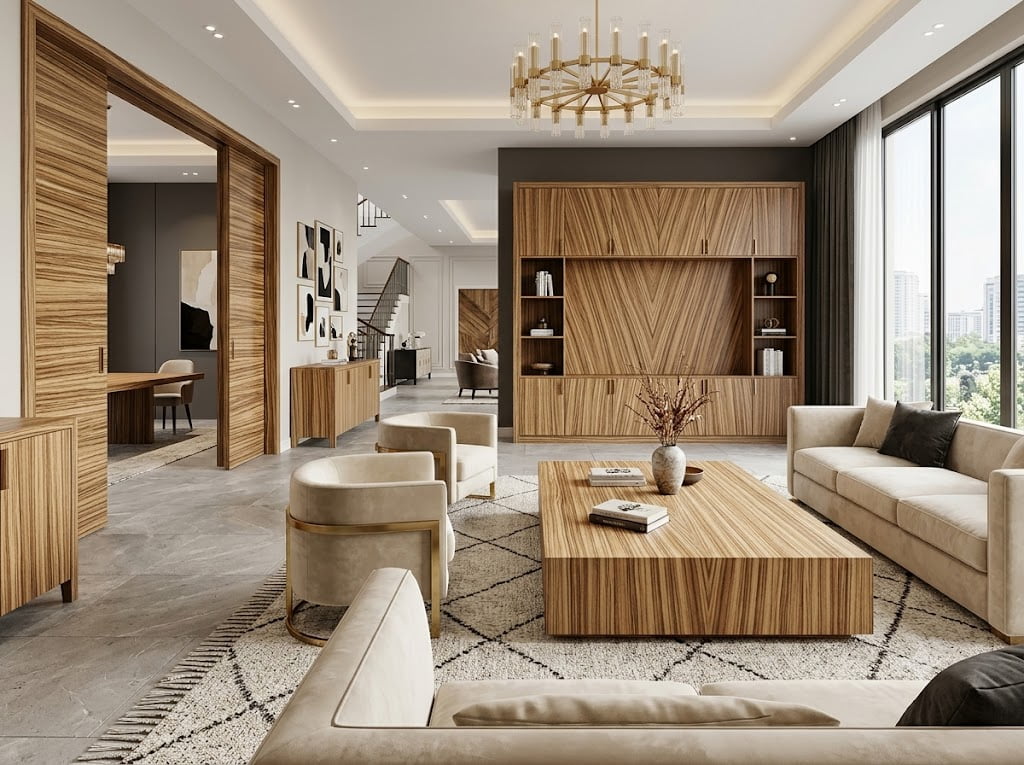
# Best Furniture Applications For Parota Plywood: Strategic Guide for Manufacturers and Designers
In the competitive landscape of contemporary furniture manufacturing, material selection represents far more than a technical specification decision—it fundamentally shapes production efficiency, cost structure, design possibilities, market positioning, and ultimately, profitability. While solid hardwood commands premium pricing and delivers unmatched visual impact for statement pieces, the economic and structural realities of volume production, dimensional stability requirements, and material utilization efficiency increasingly drive manufacturers toward engineered wood solutions that balance aesthetic appeal with practical performance.
For furniture businesses seeking to capture parota’s distinctive golden-brown warmth, dramatic grain patterns, and organic character—visual qualities that command premium positioning and differentiate products in crowded markets—while simultaneously addressing the dimensional movement challenges, cost constraints, and material waste issues inherent in solid wood construction, **parota plywood** presents a strategic material solution that bridges these competing demands.
Yet despite parota plywood’s growing availability in international markets and increasing adoption by manufacturers from Mexico to Southeast Asia, comprehensive application guidance remains limited. Production managers evaluating the material face critical unanswered questions: Which furniture components maximize parota plywood’s aesthetic value while leveraging its structural advantages? Where does the material deliver superior performance compared to solid wood alternatives? In which applications does parota plywood represent false economy—where solid wood remains the better choice despite higher material cost? How should designers detail joinery, edge treatment, and finishing to optimize both appearance and durability?
This definitive strategic guide addresses these questions systematically, examining **optimal furniture applications** for parota plywood across residential, commercial, and specialty categories. From analyzing structural suitability and cost-performance advantages to providing specific construction recommendations and identifying applications where alternative materials prove superior, this comprehensive analysis equips furniture designers, production engineers, purchasing managers, and manufacturing executives with the decision framework to deploy parota plywood strategically—maximizing its benefits while avoiding inappropriate applications that compromise quality or profitability.
—
## Understanding Parota Plywood: Material Characteristics and Performance Profile
Before examining specific applications, establishing a clear understanding of parota plywood’s fundamental characteristics provides the foundation for informed application decisions.
### Construction and Manufacturing
**What is Parota Plywood?**
**Basic Structure:**
– **Definition:** Engineered panel product consisting of thin parota wood veneers bonded together with adhesive under heat and pressure
– **Core construction:** Multiple thin layers (plies) with alternating grain direction
– **Face veneers:** Parota veneer on one or both faces (depending on grade)
– **Core materials:** Can vary (all-parota core, mixed hardwood core, or alternative materials)
**Standard Construction Types:**
**1. All-Parota Plywood:**
– **Structure:** All plies cut from parota logs
– **Advantages:** Consistent species throughout; superior screw-holding in edges; best structural properties
– **Cost:** Highest material cost
– **Availability:** Limited (most parota plywood uses composite cores)
**2. Parota Face/Hardwood Core:**
– **Structure:** Parota face veneers over mixed tropical hardwood core plies
– **Advantages:** Cost reduction while maintaining parota appearance on visible faces
– **Performance:** Excellent for most applications
– **Market position:** Most common commercial configuration
**3. Parota Face/Poplar or Similar Core:**
– **Structure:** Parota faces over lighter, less expensive core species
– **Advantages:** Further cost reduction; lighter weight
– **Considerations:** Reduced edge screw-holding; density mismatch can cause finishing challenges
– **Applications:** Suitable for non-structural panels, decorative applications
**4. Parota Face/MDF or Particleboard Core:**
– **Structure:** Parota veneer bonded to MDF or particleboard substrate
– **Technically:** Not true “plywood” (composite panel)
– **Advantages:** Excellent dimensional stability; smooth substrate for veneer; cost-effective
– **Limitations:** Lower structural strength; moisture sensitivity; edge treatment challenges
– **Applications:** Furniture doors, drawer fronts, decorative panels
**Manufacturing Regions:**
**Primary Sources:**
– **Mexico:** Guadalajara region (Jalisco); integrated with solid parota sawmilling
– **Central America:** Guatemala, Honduras (smaller volumes)
– **Import Consideration:** Some Asian manufacturers now producing parota plywood using imported logs or veneer
**Quality Considerations:**
– **Veneer thickness:** Face veneer thickness critically impacts sandability, refinishing potential (range: 0.4mm-3mm+)
– **Adhesive type:** Urea-formaldehyde (interior), phenol-formaldehyde (exterior), or PVA (interior)
– **Void-free core:** Premium grades have no gaps, overlaps, or voids in core plies
– **Sanding quality:** Better grades factory-sanded to consistent thickness with smooth surface
### Key Performance Characteristics
**Dimensional Stability (Primary Advantage):**
**Why Plywood More Stable Than Solid Wood:**
– **Cross-grain construction:** Alternating grain direction in adjacent plies restricts movement
– **Balanced construction:** Face veneers on both sides create symmetrical structure preventing warping
– **Reduced seasonal movement:** Expansion/contraction reduced to approximately **1/3 to 1/5** that of solid wood
**Practical Benefits:**
✅ **Large panels remain flat:** 4’x8′ panels don’t cup, twist, or warp like wide solid boards
✅ **Seasonal stability:** Minimal movement with humidity changes (critical for doors, cabinet cases)
✅ **Joinery reliability:** Joints don’t fail due to wood movement stress
✅ **Finish durability:** Reduced movement means less finish cracking, checking
**Strength and Structural Performance:**
**Bending Strength:**
– **Performance:** Excellent stiffness across panel width and length (bidirectional strength)
– **Comparison to solid wood:** Slightly lower than equivalent solid parota in primary grain direction, but **superior cross-grain strength**
– **Applications:** Self-supporting shelves, table/desk tops span farther without supports than solid wood
**Impact Resistance:**
– **Performance:** Good resistance to denting, damage
– **Thickness relationship:** Thicker plywood (18mm+) quite robust
– **Edge vulnerability:** Edges more susceptible to damage than faces
**Screw-Holding:**
– **Face screws:** Excellent holding power
– **Edge screws:** Good with all-parota or hardwood core; reduced with softer cores
– **Improvement techniques:** Pilot holes, appropriate screw types, edge reinforcement enhance holding
**Weight Considerations:**
**Density Range:**
– **All-parota plywood:** ~500-550 kg/m³ (similar to solid parota)
– **Parota face/hardwood core:** ~450-550 kg/m³ (depends on core species)
– **Parota face/lightweight core:** ~400-500 kg/m³
**Design Implications:**
✅ **Lighter than many solid hardwoods:** Easier handling, reduced shipping costs
✅ **Strength-to-weight ratio:** Excellent performance per unit weight
⚠️ **Not “light” for large panels:** 4’x8′ sheet of 18mm plywood still weighs 30-40 kg (65-88 lbs)
**Cost-Performance Advantages:**
**Material Utilization:**
– **Yield efficiency:** Plywood panels have **zero waste** (vs. 40-60% waste common with solid lumber milling)
– **Consistent quality:** Every square foot usable (no knots, checks, waste areas to avoid)
– **Sizing flexibility:** Cut to exact dimensions needed without concerns about grain direction
**Labor Efficiency:**
– **Reduced milling:** No need to joint, plane, glue-up wide panels
– **Faster production:** Panels ready to cut and assemble
– **Predictable machining:** Consistent density means uniform tool performance
**Material Cost:**
– **Price comparison:** Parota plywood typically **30-50% less expensive** per square foot than equivalent solid lumber
– **Total cost consideration:** Labor savings plus material savings compounds cost advantage
**Aesthetic Considerations:**
**Visual Quality:**
✅ **Face appearance:** Premium grades deliver beautiful parota figure, color
✅ **Consistency:** Factory-graded faces provide predictable visual quality
✅ **Large seamless panels:** Achieve expanses impossible with solid wood without visible joints
**Limitations:**
⚠️ **Edge appearance:** Plywood edges show laminated structure (require edge banding, solid wood edge treatment)
⚠️ **Depth perception:** Lacks the solid mass visual of thick hardwood slabs
⚠️ **Live-edge impossible:** Cannot replicate natural-edge aesthetic of solid wood
⚠️ **Premium positioning:** May be perceived as “less authentic” than solid wood in ultra-premium market segment
—
## Optimal Applications: Where Parota Plywood Excels
Understanding where parota plywood delivers maximum value—both functionally and economically—enables strategic material deployment.
### Cabinet Construction: Primary Application Strength
Parota plywood’s dimensional stability, large panel format, and cost efficiency make cabinetry its **single strongest application category**.
#### Kitchen Cabinets
**Cabinet Boxes/Cases:**
**Why Plywood Ideal:**
✅ **Dimensional stability:** No seasonal expansion that causes doors to bind
✅ **Large panels:** 4’x8′ sheets enable efficient cutting patterns for box components
✅ **Structural rigidity:** Cross-grain construction provides excellent box strength
✅ **Screw-holding:** Face screws for hinges, shelf pins hold reliably
✅ **Moisture resistance:** Better than solid wood in humid kitchen environments (especially with exterior-grade adhesive)
**Construction Specifications:**
**Recommended Thickness:**
– **Cabinet sides:** 15-18mm (5/8″-3/4″)
– **Cabinet backs:** 6-9mm (1/4″-3/8″) for frameless; 12mm (1/2″) for framed
– **Shelves:** 18-25mm (3/4″-1″) depending on span
– **Cabinet tops/bottoms:** 15-18mm
**Joinery Methods:**
– **Box joints:** Rabbet joints, dado joints for box assembly
– **Biscuit joinery:** Effective for face-frame attachment
– **Pocket screws:** Common in modern cabinet construction
– **Confirmat screws:** European-style cabinets (excellent holding in plywood edges)
**Finishing:**
– **Clear finishes:** Showcase parota’s warm golden tones
– **Catalyzed lacquer:** Durable choice for kitchen environment
– **Water-based polyurethane:** Low-VOC option with good durability
– **Oil finish:** Beautiful but requires more maintenance in kitchen setting
**Market Positioning:**
– **Mid-to-high-end residential:** Parota provides premium aesthetic at price point below solid wood frame-and-panel construction
– **Custom cabinetry:** Distinctive appearance differentiates custom shops from stock cabinet manufacturers
– **Hospitality:** Hotels, restaurants value combination of aesthetic appeal and durability
**Cabinet Doors and Drawer Fronts:**
**Plywood vs. Solid Wood Decision Matrix:**
**When Parota Plywood Excels:**
✅ **Flat-panel (slab) doors:** Plywood perfect for clean, contemporary designs
✅ **Wide doors:** Over 500mm (20″) width—plywood superior stability
✅ **Tall doors:** Full-height pantry, appliance cabinet doors—won’t warp
✅ **Inset construction:** Tight reveals demand dimensional stability plywood provides
✅ **Cost sensitivity:** Plywood significantly reduces material cost in door production
**Construction Details:**
**Edge Treatment (Critical):**
Plywood edges show laminated structure—must be concealed or finished:
**Option 1: Solid Wood Edge Banding**
– **Method:** Solid parota strips glued to all four edges
– **Advantages:** Creates appearance of solid wood door; allows profiled edges; excellent durability
– **Thickness:** 3-6mm typical
– **Application:** Glue and clamp or specialized edge bander equipment
– **Finishing:** Sand/shape edges flush with faces
**Option 2: Veneer Edge Tape**
– **Method:** Thin (0.4-1mm) parota veneer tape applied to edges
– **Advantages:** Fast application (iron-on or adhesive-backed); minimal thickness added; economical
– **Considerations:** Less durable than solid edging; limited shaping capability
– **Best applications:** Contemporary designs with simple, square edges
**Option 3: Aluminum or PVC Edge Profile**
– **Method:** Metal or plastic trim covers edges
– **Advantages:** Modern aesthetic; extremely durable; fast installation
– **Considerations:** Not suitable for traditional designs; changes aesthetic character
– **Applications:** Contemporary, industrial, or commercial designs
**Option 4: Exposed Plywood Edge (Contemporary Design)**
– **Method:** Sand smooth and finish exposed plywood laminations
– **Advantages:** Honest material expression; no additional labor/materials
– **Aesthetic:** Works in modern, Scandinavian, or industrial design contexts
– **Consideration:** Must be intentional design choice (not acceptable in traditional cabinetry)
**Panel Shaping:**
– **Routing:** Plywood accepts router profiles on edges (requires solid edging first)
– **Raised panels:** Not practical with thin face veneers (veneer too thin to shape)
– **Curved doors:** Can be bent (specialized process; limited availability)
**Hardware Integration:**
– **Hinge boring:** Standard 35mm hinge cups work perfectly
– **Pull boring:** Accepts drill bits cleanly
– **Reinforcement:** Consider backing plates for heavy pulls on thin plywood
**Drawer Fronts:**
**Specifications:**
– **Thickness:** 15-18mm most common (5/8″-3/4″)
– **Edge treatment:** Same options as doors (solid banding typically preferred)
– **Construction:** Simpler than doors (no frame, panel considerations)
**Advantages:**
✅ **Flat, stable:** Won’t warp even on wide drawers
✅ **Consistent thickness:** No thickness variation to accommodate in box construction
✅ **Cost-effective:** Significantly less expensive than solid wood
**Drawer Boxes (Secondary Application):**
**Typical Practice:**
– Most manufacturers use **Baltic birch, maple, or other light-colored plywood** for drawer boxes (not parota)
– **Rationale:** Drawer interiors hidden; light-colored wood creates clean appearance; parota plywood more expensive than necessary
**When Parota Plywood Used:**
– **Premium applications:** Where drawer interior visibility important (bathroom vanities, display drawers)
– **Design continuity:** Matching interior to exterior in transparent or glass-front cabinets
– **Branding:** Ultra-premium projects where “all parota” construction marketed
**Recommendation:** Reserve parota plywood for visible components; use economical species for concealed drawer boxes.
#### Bathroom Vanities
**Application Suitability:** **Excellent**
**Why Parota Plywood Ideal:**
✅ **Moisture resistance:** Better performance than solid wood in humid bathroom environment
✅ **Dimensional stability:** Won’t expand/contract with humidity fluctuations
✅ **Warm aesthetic:** Golden tones create inviting, spa-like atmosphere
✅ **Custom sizing:** Accommodates non-standard vanity dimensions easily
**Construction Specifications:**
**Recommended Components:**
– **Cabinet cases:** 18mm (3/4″) plywood
– **Doors/drawer fronts:** 15-18mm with solid wood edge banding
– **Open shelving:** 18-25mm depending on span
– **Toe kicks:** 12-15mm (or solid wood)
**Critical Finishing Requirement:**
– **Sealing essential:** Use **waterproof topcoats** (catalyzed lacquer, marine spar varnish, or specialized waterproof finishes)
– **Edge sealing:** Pay special attention to sealing all plywood edges (most vulnerable to moisture penetration)
– **Penetration prevention:** Multiple coats needed on horizontal surfaces near sink
**Design Considerations:**
– **Backsplash integration:** Plywood works well for integrated backsplash (better than tile in some contemporary designs)
– **Floating vanities:** Plywood’s strength-to-weight ratio ideal for wall-mounted vanities
– **Storage integration:** Easy to incorporate internal partitions, drawer dividers
**Market Position:**
– **Custom residential:** Distinctive material choice for upscale bathroom remodels
– **Boutique hotels:** Creates signature aesthetic in guest bathrooms
– **High-end multi-family:** Developers seeking differentiation in luxury condo/apartment buildings
#### Built-In Furniture and Millwork
**Entertainment Centers and Media Cabinets:**
**Suitability:** **Excellent**
**Why Ideal:**
✅ **Large panels:** Accommodate expansive entertainment wall units
✅ **Equipment integration:** Easy to cut openings for electronics, cable management
✅ **Strength:** Shelves support heavy AV equipment without sagging
✅ **Stability:** Doors remain aligned despite seasonal changes
**Construction Notes:**
– **Shelf spans:** 18mm plywood reliably spans 900mm (36″) for AV equipment; 25mm spans 1200mm (48″)
– **Back panels:** Consider 6-9mm
Comments