
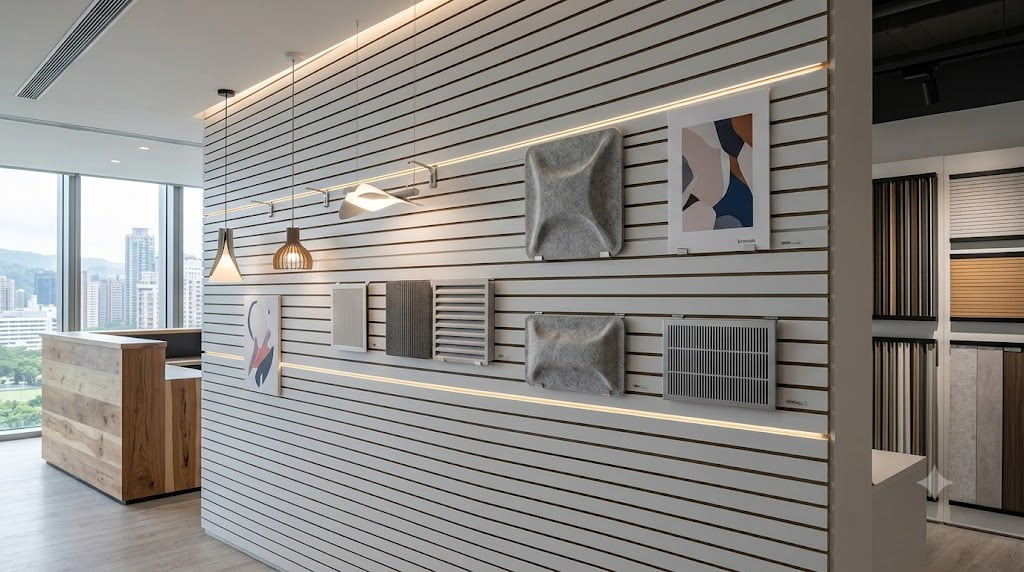
What Is Slotted MDF Board? Complete Guide for Retail Display and Store Fixtures
Slotted MDF board—also known as slatwall panel or grooved MDF—has become the industry-standard material for retail display systems, store fixtures, and commercial merchandising solutions worldwide. As a leading slotted MDF board manufacturer and supplier, we understand that retail store owners, fixture manufacturers, and commercial space planners require versatile, cost-effective display systems that combine durability, aesthetic flexibility, and accessory compatibility. Slotted MDF board delivers all these advantages through its engineered design: horizontal grooves precisely cut into high-density MDF panels that accept specialized display hardware including hooks, shelves, brackets, and bins.
Whether you’re outfitting a retail clothing store, electronics showroom, warehouse display area, or trade show booth, slotted MDF board provides the modular flexibility essential for modern merchandising strategies. This comprehensive guide covers everything from manufacturing specifications and finish options to installation methods and wholesale supply considerations for B2B buyers sourcing materials for commercial display projects.
- What is Slotted MDF Board?
- Types of Slotted MDF Board
- Applications of Slotted MDF Board in Retail and Commercial Spaces
- Slotted MDF Board vs Other Display Systems
- Technical Specifications and Load Capacity
- Installation Methods for Slotted MDF Panels
- Accessories and Hardware for Slotted MDF Board
- Custom Slotted MDF Board Manufacturing
- Frequently Asked Questions
What is Slotted MDF Board?
Slotted MDF board consists of medium-density fiberboard (MDF) panels precision-cut with horizontal grooves (slots) running across the panel surface at regular intervals. These slots—typically spaced 3 inches or 4 inches on center—accept specialized metal brackets, hooks, and display accessories that enable flexible merchandise presentation without drilling or permanent hardware installation. The system originated in the retail fixture industry as a cost-effective alternative to aluminum slatwall, offering similar functionality with improved aesthetics and lower material costs.

The MDF substrate provides an ideal foundation for slotted panel systems due to its uniform density, smooth surface characteristics, and exceptional machinability. Unlike solid wood or plywood alternatives, MDF maintains consistent dimensions across large panels without warping, grain variation, or natural defects that compromise slot precision. This dimensional stability ensures accessories fit securely regardless of panel location—a critical factor for retail applications where display hardware must support merchandise weight safely and reliably.
Modern slotted MDF boards are available in standard panel sizes (4×8 feet, 4×10 feet) with thickness options ranging from 15mm to 18mm depending on load capacity requirements. Surface finishing options include melamine lamination in various colors, decorative laminate application, painted finishes, or raw MDF for on-site finishing. The panels function as modular building blocks for comprehensive retail fixture systems including wall displays, free-standing gondolas, end caps, and custom merchandising units.
How Slotted MDF Board is Manufactured
Professional slotted MDF board production involves precision manufacturing processes that ensure consistent slot dimensions and spacing critical to accessory compatibility and system performance:
Step 1 – MDF Substrate Selection: High-density MDF panels (density 700-850 kg/m³) are selected based on thickness specifications and quality grade. Premium slotted panel systems utilize moisture-resistant MDF formulations that provide enhanced dimensional stability in climate-controlled retail environments and resist edge swelling from handling during installation.
Step 2 – Surface Finishing: If specified, MDF panels receive surface treatment before slot cutting. Melamine facing—the most common finish option—involves heat-pressing decorative melamine paper to panel faces under high temperature and pressure. This creates durable, moisture-resistant surfaces available in solid colors (white, black, maple, oak) or wood grain patterns. Alternative finishes including laminate application or primer/paint coating are applied at this stage.
Step 3 – Precision Slot Cutting: Finished panels pass through CNC router systems or specialized grooving machines equipped with carbide cutters that mill horizontal slots across panel width. Cutting parameters are precisely controlled to produce consistent slot dimensions: typical specifications include 12mm-15mm groove depth, 6mm groove width, with slots spaced 75mm (3 inches) or 100mm (4 inches) on center measured from slot centerline to centerline.
Step 4 – Edge Treatment: Panel edges receive finishing treatment including sanding, edge-banding application (for melamine or laminate panels), or paint/sealer coating. Edge finishing prevents moisture absorption, improves appearance, and protects panel edges from damage during handling and installation.
Step 5 – Quality Control: Finished panels undergo inspection to verify slot spacing accuracy (tolerance ±0.5mm), groove depth consistency, surface finish quality, and dimensional conformance. Premium manufacturers implement statistical process control to maintain tight tolerances essential for multi-panel installations where slot alignment across adjacent panels is critical.
Standard Slot Dimensions and Spacing
Industry-standard slotted MDF boards follow established dimensional specifications that ensure compatibility with commercially available display accessories manufactured globally. Understanding these standards enables procurement managers to specify materials confidently and ensures accessories function properly regardless of supplier:
Slot Spacing Options:
- 3-inch on center (75mm): Most common spacing for general retail displays, providing maximum flexibility for accessory positioning at close intervals. This spacing supports high-density merchandise presentation and allows precise vertical adjustment of hooks and shelves.
- 4-inch on center (100mm): Alternative spacing offering slightly reduced hardware density suitable for larger merchandise items or applications where wider slot spacing provides adequate positioning flexibility while reducing panel production costs.
Slot Profile Dimensions:
- Groove Width: 6mm-7mm (approximately 1/4 inch) – sized to accept standard accessory mounting tabs with minimal play while allowing easy insertion and removal
- Groove Depth: 12mm-15mm (approximately 1/2 inch) – provides sufficient engagement depth for accessory tabs to seat securely and support specified load capacity
- Groove Profile: Undercut T-slot design with wider base than opening creates mechanical locking that prevents accessories from pulling out under load
These standardized dimensions represent decades of industry evolution and are maintained by major manufacturers worldwide to ensure universal accessory compatibility—a critical factor enabling retail fixture systems to utilize hardware from multiple suppliers interchangeably.
Types of Slotted MDF Board
Slotted MDF boards are manufactured with various surface finishes and specifications designed to meet specific aesthetic requirements, performance criteria, and budget parameters. Understanding the characteristics and advantages of each type enables project planners to select optimal materials for their retail fixture applications.

Melamine Faced Slotted MDF
Melamine faced slotted MDF represents the most popular option for retail fixture applications, combining durability, aesthetic versatility, and cost-effectiveness. The melamine surface consists of decorative paper impregnated with melamine resin and thermally fused to MDF substrate under heat and pressure—creating a hard, moisture-resistant surface that withstands the rigors of commercial retail environments.
Advantages: Scratch-resistant surface, moisture resistance superior to painted MDF, wide color selection (solid colors and wood grain patterns), no additional finishing required, easy to clean and maintain, consistent appearance across large installations. The pre-finished nature eliminates on-site painting labor and accelerates installation schedules critical to retail store construction timelines.
Common Colors: White (most popular for contemporary retail), black, maple wood grain, oak wood grain, gray, beige, and custom colors available for large-volume orders. White melamine slotted MDF dominates retail fixture applications due to its neutral appearance that highlights merchandise rather than competing with product presentation.
Applications: Retail clothing stores, electronics showrooms, sporting goods retailers, gift shops, pharmacy displays, convenience store fixtures—essentially any commercial display application where durable, attractive finish is required immediately upon installation.
Laminate Finished Slotted MDF
Laminate finished slotted MDF features high-pressure decorative laminate (HPL) bonded to MDF substrate, providing superior durability and design flexibility compared to melamine options. The laminate surface consists of multiple kraft paper layers impregnated with phenolic resin and topped with decorative layer, compressed under extreme pressure and temperature to create exceptionally hard, wear-resistant surfaces.
Advantages: Superior abrasion resistance, enhanced impact resistance, greater design options including premium wood grains and textures, suitable for high-traffic commercial applications, excellent chemical resistance, longer service life in demanding retail environments. Laminate surfaces withstand heavy use without showing wear patterns common in melamine finishes after extended service.
Applications: High-end retail boutiques, jewelry store fixtures, museum display systems, trade show booths requiring premium appearance, corporate showrooms, automotive dealership displays—applications where visual impact and long-term durability justify
Comments