
Ultimate Guide to Block Board: Uses, Advantages and Buying Tips
Block board has emerged as one of the most versatile and cost-effective engineered wood products for furniture manufacturing, interior construction, and commercial fixtures worldwide. As a leading block board manufacturer and supplier, we serve furniture factories, door manufacturers, interior contractors, and building material distributors who require reliable, high-quality engineered wood panels that balance performance, workability, and economic value. Block board’s unique construction—featuring solid wood core strips sandwiched between cross-band layers and face veneers—delivers advantages including lightweight structure, excellent screw-holding capacity, dimensional stability, and superior strength-to-weight ratio compared to alternative panel products.
Whether you’re a furniture manufacturer evaluating materials for wardrobe production, a contractor specifying door cores for commercial projects, or a purchasing manager sourcing engineered wood panels for bulk orders, understanding block board specifications, quality factors, and application suitability is essential for making informed procurement decisions. This comprehensive guide covers everything from construction methods and core material types to practical selection criteria and wholesale buying considerations tailored specifically for B2B buyers in the furniture and construction industries.
- What is Block Board?
- Types of Block Board by Core Material
- Block Board Specifications: Thickness, Sizes and Grades
- Block Board vs Plywood vs MDF: What’s the Difference?
- Advantages of Block Board for Furniture and Construction
- Disadvantages and Limitations of Block Board
- Common Applications of Block Board
- How to Choose Quality Block Board: Selection Criteria
- Block Board Pricing Factors and Cost Considerations
- Block Board Buying Guide for Bulk Orders
- Frequently Asked Questions
What is Block Board?
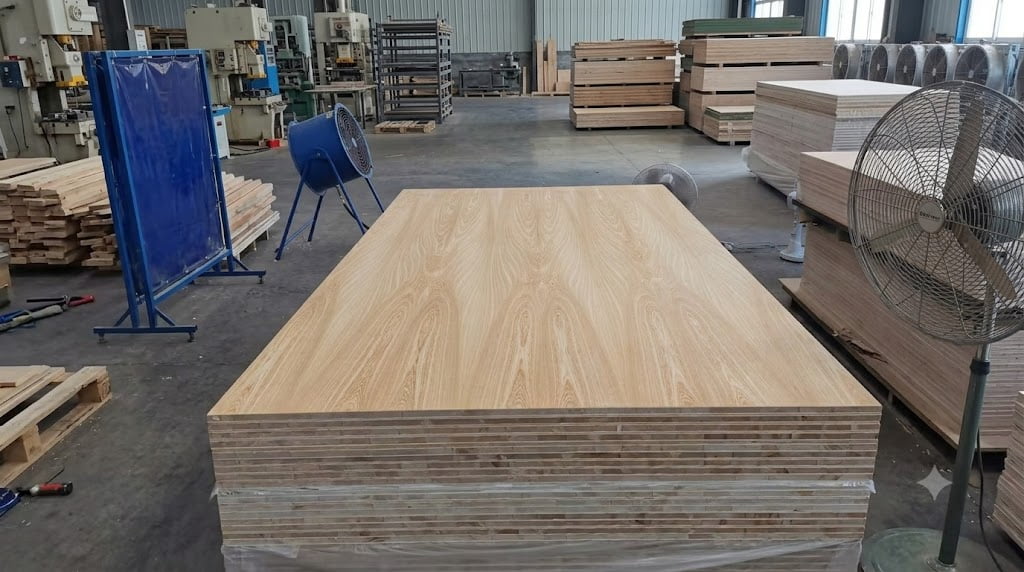
Block board is an engineered wood panel product constructed from solid wood strips (blocks) arranged edge-to-edge to form the core layer, which is then sandwiched between thin cross-band veneers and finished with face veneers on both outer surfaces. This multi-layer construction creates a stable, lightweight panel that combines the natural characteristics of solid wood with the dimensional stability and workability advantages of engineered wood products. Block board belongs to the broader category of composite wood panels but distinguishes itself through its solid wood core construction—a feature that provides superior screw-holding strength and structural integrity compared to particle board or MDF alternatives.

The term “block board” derives from the solid wood blocks or strips that form the panel’s core structure. Unlike plywood (which uses continuous veneer sheets throughout) or particle board (which uses compressed wood particles), block board utilizes relatively wide solid wood strips—typically 20-30mm in width—arranged parallel to each other with minimal gaps. This core construction method provides several performance advantages while maintaining efficient material utilization and cost-effectiveness essential for industrial-scale furniture and construction applications.
Block board is manufactured globally under various national standards including Indian Standard IS:1659, Chinese National Standard GB/T, and other regional specifications that define construction requirements, quality grades, and performance characteristics. Premium manufacturers adhere to these standards while implementing additional quality control measures to ensure consistent core construction, proper adhesive application, and face veneer quality critical to end-product performance.
Block Board Construction and Layers
Understanding block board’s layered construction is essential for evaluating quality and predicting performance in different applications. A standard block board panel consists of five primary structural layers working together to create the finished product:
Layer 1 – Face Veneer (Top Surface): The uppermost visible layer consists of decorative wood veneer typically ranging from 0.5mm to 1.5mm thickness. Face veneer selection depends on the intended application and finish—natural wood veneers (teak, oak, ash, walnut) for furniture requiring clear finishes, commercial grade veneers for painted applications, or decorative laminate for specialized finishes. Premium block board utilizes carefully selected face veneers free from defects including knots, splits, or color variation that would compromise appearance in visible applications.
Layer 2 – Cross Band Veneer (Top): Positioned between the face veneer and core, the cross band consists of thin wood veneer (1.5mm-3mm) oriented perpendicular (90 degrees) to the core strip direction. This cross-grain orientation provides dimensional stability by counteracting the core’s tendency to expand or contract along the grain direction, significantly reducing warping and twisting compared to panels lacking proper cross-banding. High-quality manufacturers use defect-free cross-band veneers properly glued under controlled pressure to ensure permanent bonding.
Layer 3 – Wood Strip Core (Center): The structural heart of block board consists of solid wood strips arranged edge-to-edge, running parallel to the panel’s length dimension. Core strip specifications significantly impact overall panel quality and performance—strip width typically ranges from 20mm to 30mm (with narrower strips generally indicating higher quality), strip thickness matches panel thickness (minus veneer thickness), and wood species selection affects weight, strength, and cost. Premium cores utilize uniform-width strips with tight edge joints and consistent wood moisture content (8-12%) to prevent gaps or joint separation during service.
Layer 4 – Cross Band Veneer (Bottom): Mirroring the top cross band, this layer also runs perpendicular to core strips and serves identical structural purposes—dimensional stabilization and balanced construction. Proper manufacturing requires symmetrical construction with matching cross-band thickness and species on both panel faces to prevent stress imbalance that causes warping.
Layer 5 – Back Veneer (Bottom Surface): The final layer provides a finished bottom surface using veneer matching or complementing the face veneer grade. While not visible in many applications (furniture backs, door concealed faces), back veneer quality affects overall panel stability and must be properly bonded to prevent delamination. Cost-conscious applications may use lower-grade back veneer compared to face veneer, though premium manufacturers maintain consistent quality across both surfaces.
How Block Board is Manufactured
Modern block board manufacturing involves precision equipment and controlled processes ensuring consistent quality suitable for demanding furniture and construction applications:
Step 1 – Core Wood Preparation: Selected timber logs undergo processing to produce core strips of specified dimensions. Logs are sawn into planks, then ripped into strips matching required width specifications (20-30mm). Core strips are kiln-dried to target moisture content (8-12%) essential for dimensional stability and proper adhesive curing. Dried strips pass through quality grading where defective pieces with excessive knots, splits, or decay are rejected.
Step 2 – Core Assembly: Prepared strips are arranged edge-to-edge on a large assembly table to form the core panel. Strip arrangement follows strict protocols—grain direction must remain consistent, strips of similar width are grouped together to minimize gaps, and any necessary joining or edge-gluing occurs at this stage. The assembled core forms a continuous panel matching final product dimensions (typically 4×8 feet or custom sizes). Quality manufacturers ensure strip edges fit tightly with minimal gaps (less than 1mm between strips) to prevent core voids that weaken the panel.
Step 3 – Cross Band Application: Cross-band veneers cut to panel dimensions receive adhesive application (typically urea-formaldehyde or phenolic resin adhesive suitable for interior or exterior use respectively). Adhesive is applied uniformly across the veneer surface using roller coaters ensuring complete coverage without excess. Cross-band sheets are positioned on both top and bottom core surfaces with grain direction perpendicular to core strip direction—a critical orientation requirement for proper dimensional stability.
Step 4 – Face Veneer Application: Face veneers undergo similar adhesive application and are carefully positioned on the cross-band layers. Face veneer selection matches specifications—natural wood species for furniture applications, commercial grades for painted finishes, or decorative options for specialized products. Proper face veneer placement ensures best face quality appears on the designated top surface while maintaining grain direction consistency across panel width.
Step 5 – Hot Pressing: The assembled panel stack (face veneer / cross band / core / cross band / back veneer) enters a multi-daylight hot press where temperature (typically 110-140°C depending on adhesive type) and pressure (0.8-1.2 MPa) cure the adhesive while compressing layers into a unified panel. Press time varies based on panel thickness and adhesive formulation but typically ranges from 8-15 minutes. Proper pressing ensures complete adhesive cure, permanent layer bonding, and flat panel geometry essential for subsequent processing and application.
Step 6 – Cooling and Conditioning: Pressed panels exit the hot press and enter controlled cooling areas where panels stabilize to ambient temperature while maintaining flat orientation under light pressure. Conditioning time allows adhesive to complete curing reactions and internal stresses to equalize, preventing warp development after release. Premium manufacturers condition panels for 24-48 hours before further processing.
Step 7 – Sizing and Sanding: Conditioned panels pass through panel saws where edges are trimmed to final dimensions ensuring square geometry and consistent size. Both panel faces undergo sanding using progressively finer abrasive grits (typically 80-150 grit depending on face veneer type and application requirements) to achieve smooth, uniform surfaces ready for finishing or direct use. Quality control inspection occurs at this stage to identify and reject panels with defects including delamination, core gaps, face veneer defects, or dimensional issues.
Step 8 – Packaging and Storage: Finished panels receive protective packaging—typically plastic wrap or paper interleaving between panels, banded in stacks on wooden pallets. Proper packaging prevents surface damage, moisture absorption, and edge damage during shipping and storage. Panels are warehoused in climate-controlled environments maintaining appropriate temperature and humidity to preserve panel quality until shipment to customers.
Comments