
Walnut Veneer vs Solid Walnut: Complete Comparison Guide for Furniture & Cabinets
Choosing between walnut veneer and solid walnut fundamentally impacts your furniture project’s cost structure, structural performance, and long-term value. As a leading walnut veneer and plywood manufacturer serving furniture makers, cabinet manufacturers, and architectural millwork companies worldwide, we supply both premium walnut veneer sheets and solid walnut lumber for projects ranging from residential cabinetry to commercial interior installations. This comprehensive guide compares walnut veneer vs solid walnut across critical dimensions—manufacturing processes, cost differentials, durability characteristics, application suitability, and aesthetic quality—enabling informed material decisions for your kitchen cabinets, wall panels, or custom furniture manufacturing projects.
- What is Walnut Veneer vs Solid Walnut?
- Walnut Veneer vs Solid Walnut: Manufacturing Process
- Walnut Veneer vs Solid Walnut Cost Comparison
- Durability: Walnut Veneer vs Solid Walnut
- Appearance: Walnut Veneer vs Solid Walnut Quality
- Walnut Veneer vs Solid Walnut for Furniture Applications
- Walnut Veneer Plywood vs Solid Walnut Boards
- Stability and Warping: Walnut Veneer vs Solid Walnut
- Maintenance: Walnut Veneer vs Solid Walnut Care
- Environmental Impact: Walnut Veneer vs Solid Walnut
- How to Identify Walnut Veneer vs Solid Walnut
- Pros and Cons: Walnut Veneer vs Solid Walnut
- When to Choose Walnut Veneer vs Solid Walnut
- Frequently Asked Questions
- Get Custom Walnut Veneer or Solid Walnut Products
What is Walnut Veneer vs Solid Walnut?
Walnut Veneer Explained
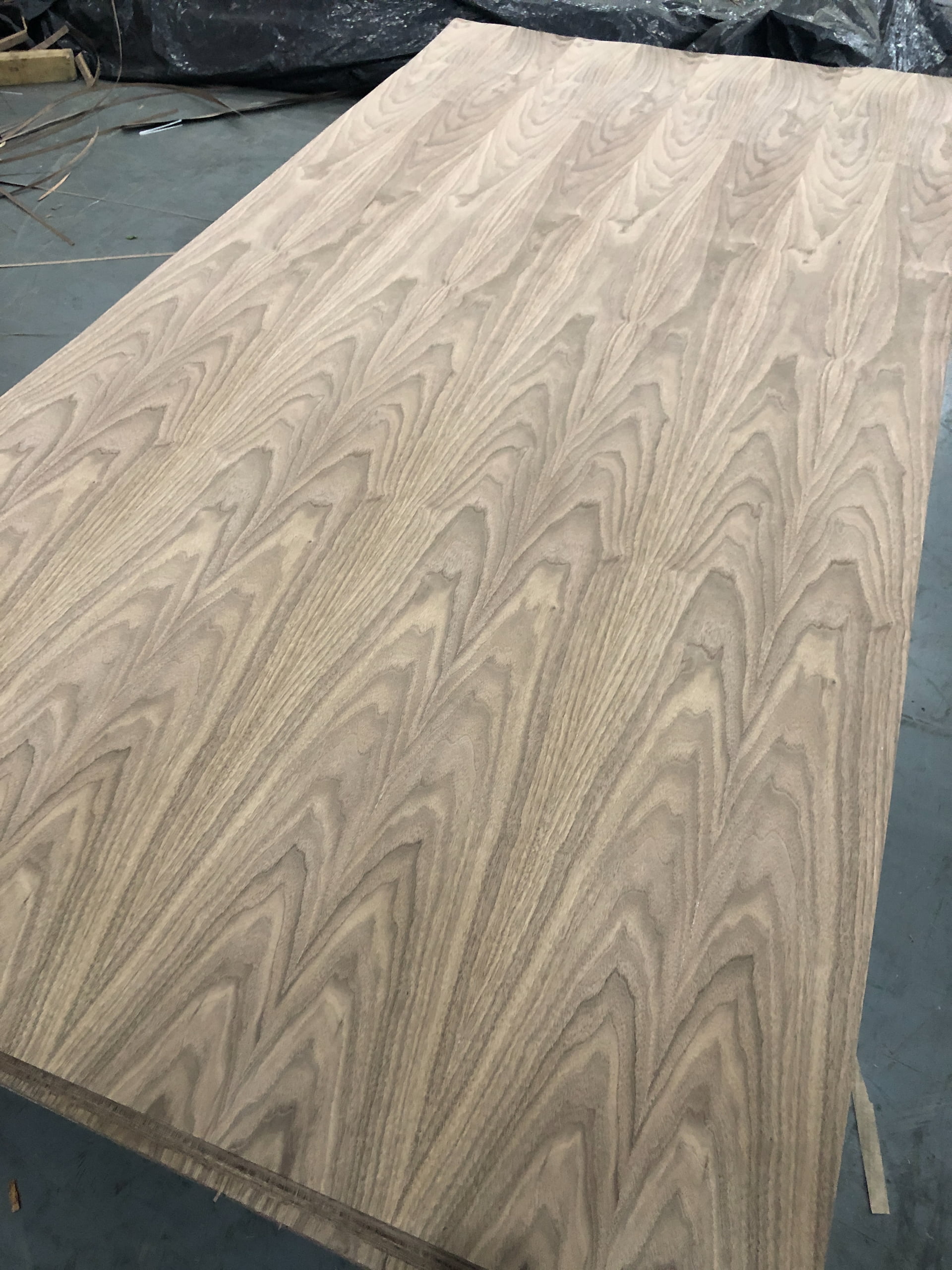
Walnut veneer consists of thin slices of genuine black walnut wood—typically 0.5mm to 1.0mm thick—precision-cut from walnut logs and bonded to stable substrate materials like plywood, MDF (medium-density fiberboard), or particle board. Professional veneer manufacturing utilizes specialized slicing equipment producing consistent thickness across entire sheets, enabling furniture manufacturers to achieve authentic walnut aesthetics at significantly reduced material costs. The veneer surface represents real walnut heartwood displaying natural grain patterns, color variations, and figure characteristics identical to solid lumber, as veneer slices come from the same species and log sources as solid boards.
Modern walnut veneer plywood construction typically features multi-ply hardwood or engineered wood cores providing dimensional stability superior to solid lumber. A-grade walnut veneer—the highest commercial quality—exhibits consistent chocolate-brown coloring, minimal defects, and carefully matched grain patterns ideal for premium cabinetry and furniture. Manufacturers produce walnut veneer through three primary cutting methods: flat-cut (plain-sliced) creating cathedral grain patterns, quarter-cut producing straight ribbon striping, and rotary-cut generating broader figure. Each method yields distinct aesthetic characteristics suited to different design applications and price points.
Solid Walnut Explained
Solid walnut refers to lumber milled directly from black walnut logs with no lamination or substrate materials—the entire board thickness consists exclusively of walnut wood. Solid walnut boards range from ¾-inch (19mm) standard furniture-grade thickness up to 8/4 (2 inches) or thicker for specialized applications like live edge slabs, table legs, and structural components. This construction method has served furniture making for centuries, offering maximum material thickness enabling extensive refinishing, deep edge profiling, and superior structural strength for load-bearing components.
Solid walnut lumber comes graded by the National Hardwood Lumber Association (NHLA) with FAS (Firsts and Seconds) representing premium quality featuring minimal defects and maximum clear face area. Select grade offers slightly more character marks while No. 1 Common contains more natural features like knots and mineral streaks valued in rustic furniture designs. Furniture manufacturers choose solid walnut primarily for visible structural elements—table bases, chair frames, solid wood doors, and carved details—where material depth enables shaping techniques impossible with thin veneer surfaces.

Walnut Veneer vs Solid Walnut: Manufacturing Process
The manufacturing processes for walnut veneer vs solid walnut diverge fundamentally, impacting efficiency, material yield, and final product characteristics. Solid walnut production begins with log selection, typically choosing straight-grain logs 16-24 inches in diameter from mature trees 60-80 years old. Sawmills cut logs into planks using plain-sawn, quarter-sawn, or rift-sawn methods, each producing different grain patterns and stability characteristics. After initial milling, solid walnut boards undergo kiln-drying reducing moisture content from 60-80% (green lumber) to 6-8% for furniture-grade material—a process requiring 4-8 weeks depending on thickness and kiln capacity.
Following drying, solid walnut receives final milling to precise thickness tolerances (typically ±0.5mm for premium grades), edge squaring, and surface planing. This traditional process yields approximately 35-40% usable lumber from original log volume after accounting for sawdust waste, edge trimming, and defect removal. The resulting boards maintain full thickness throughout, enabling furniture makers to perform extensive machining, edge routing, and refinishing throughout the product lifecycle.
Walnut veneer manufacturing achieves dramatically higher yield efficiency by slicing logs into thin sheets rather than cutting thick planks. The process begins with log selection emphasizing figure quality and color consistency rather than structural straightness. Manufacturers steam or boil logs at 180-212°F for 24-72 hours, softening wood fibers enabling precision slicing. A specialized veneer lathe or slicer then cuts continuous sheets 0.5-1.0mm thick from rotating or stationary logs, producing 20-30 times more surface area per log compared to solid lumber milling.
Premium walnut veneer receives careful drying, flattening, and quality grading before bonding to substrate panels. Modern plywood manufacturers layer walnut veneer over multi-ply hardwood cores using urea-formaldehyde or phenolic adhesives under heat and pressure, creating dimensionally stable panels resistant to warping. This engineered construction method produces furniture-grade panels at 60-75% lower cost per square foot than equivalent solid walnut boards while maximizing utilization of valuable walnut timber resources.
Walnut Veneer vs Solid Walnut Cost Comparison
Cost analysis reveals substantial advantages favoring walnut veneer for budget-conscious furniture manufacturers and large-scale architectural projects. Current wholesale pricing for FAS-grade solid walnut lumber ranges $12-18 per board foot (based on thickness and width), translating to approximately $16-24 per square foot for standard ¾-inch material. Premium figured walnut exhibiting exceptional grain patterns commands $25-40 per board foot, with costs escalating further for wide boards exceeding 12 inches. These prices reflect walnut’s slow growth, limited supply, and increasing demand from domestic and international furniture markets.
In comparison, A-grade walnut veneer plywood typically costs $45-75 per 4×8 sheet (32 square feet) for ¾-inch thickness—equivalent to $1.40-2.35 per square foot. This represents 85-92% cost savings compared to solid walnut while providing identical surface aesthetics for cabinet doors, panel applications, and furniture faces where structural thickness offers no functional advantage. Even accounting for substrate costs and manufacturing complexity, walnut veneer plywood delivers exceptional value for projects requiring authentic walnut appearance across large surface areas.
For a typical kitchen cabinet project requiring 200 square feet of material, solid walnut lumber would cost $3,200-4,800 versus $280-470 for equivalent walnut veneer plywood—a difference of $2,920-4,330 per project. These savings enable furniture manufacturers to specify premium walnut aesthetics for middle-market residential projects otherwise limited to laminate or lower-grade wood species. Commercial interior designers increasingly specify walnut veneer wall panels for hotel lobbies, office reception areas, and retail spaces where solid walnut costs would exceed project budgets.
However, cost comparison must account for application-specific requirements. Solid walnut edges require no banding or edge treatment, potentially reducing labor costs for doors and table components where exposed edges remain visible. Walnut veneer panels require edge banding application adding $2-5 per linear foot for premium solid walnut edge tape matching veneer color and grain. For structural furniture components requiring deep mortise joints, carved details, or extensive shaping, solid walnut’s full thickness justifies premium pricing despite higher material costs.

Comments