
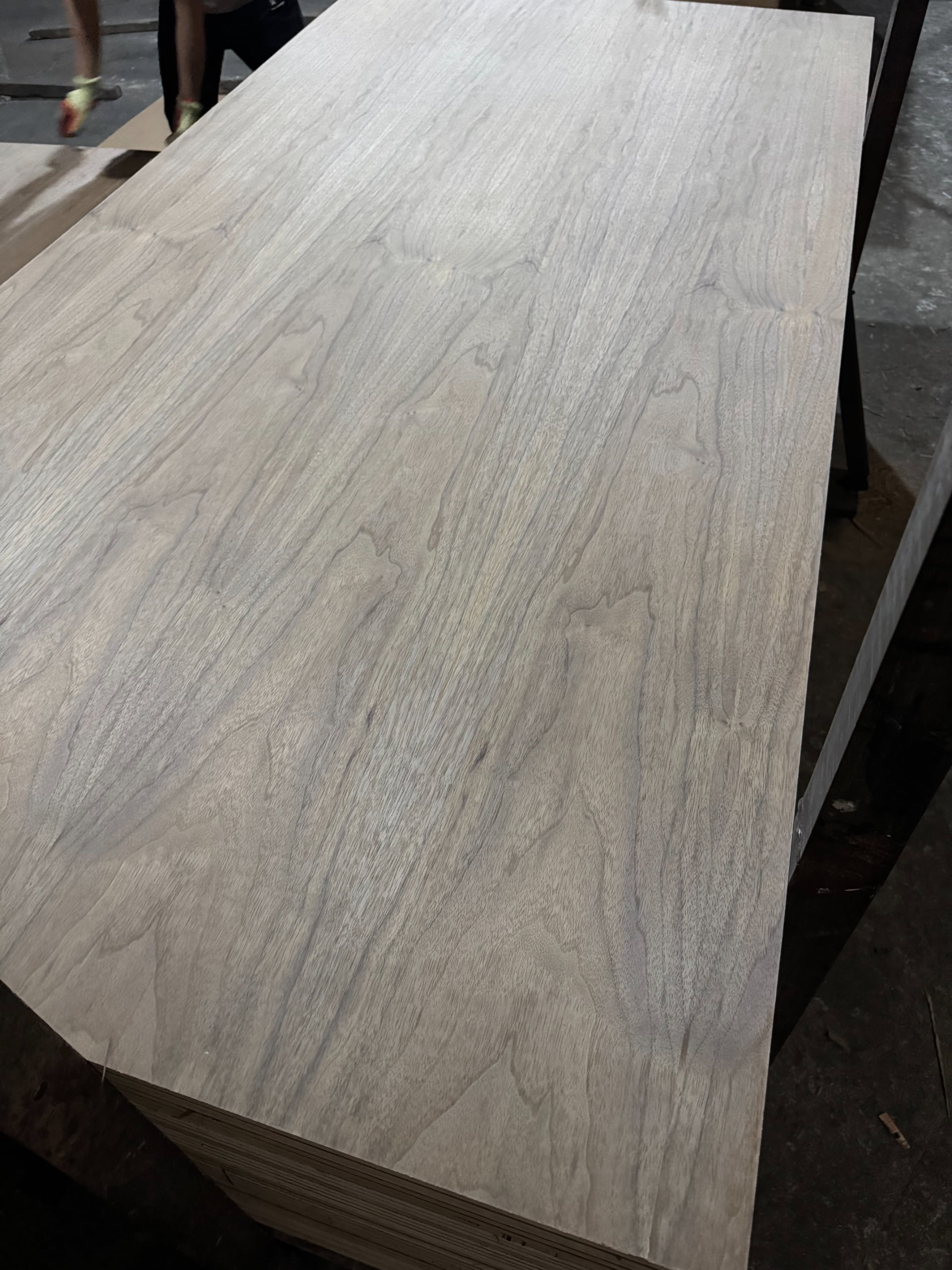
Walnut Plywood Wholesale Guide: Pricing, MOQ & Supplier Selection
Purchasing walnut plywood wholesale enables furniture manufacturers, cabinet makers, and interior contractors to achieve 40-65% cost savings compared to retail pricing while securing consistent material supply for production schedules. As a direct walnut plywood manufacturer serving wholesale buyers across North America, Europe, and Asia since 2008, we supply premium walnut veneer plywood in container quantities with flexible MOQ starting at one 20-foot container (approximately 2,000 sheets). This comprehensive wholesale guide covers pricing structures, quality grading systems, supplier selection criteria, container capacity calculations, and negotiation strategies—equipping procurement managers and business owners with actionable information for cost-effective walnut plywood sourcing whether you’re furnishing custom kitchens, manufacturing office furniture, or executing commercial interior projects.
- What is Walnut Plywood Wholesale?
- Walnut Plywood Wholesale Pricing Structure
- Types of Walnut Plywood Available Wholesale
- Quality Grades for Walnut Plywood Wholesale
- Minimum Order Quantity (MOQ) for Walnut Plywood
- How to Calculate Container Capacity
- Wholesale Walnut Plywood Specifications
- How to Choose a Walnut Plywood Wholesale Supplier
- Walnut Plywood Wholesale Buying Process
- Payment Terms for Wholesale Orders
- Quality Control and Inspection
- Shipping and Logistics for Bulk Orders
- Cost Factors Affecting Wholesale Prices
- Tips for Negotiating Better Wholesale Prices
- Common Mistakes When Buying Walnut Plywood Wholesale
- Frequently Asked Questions
- Get Wholesale Walnut Plywood Quote
What is Walnut Plywood Wholesale?
Walnut plywood wholesale refers to bulk purchasing directly from manufacturers or authorized distributors at substantially reduced per-unit pricing compared to retail channels. Wholesale transactions typically involve container-load quantities (1,800-2,500 sheets per 20-foot container) with pricing structures reflecting economies of scale in production, reduced sales overhead, and direct factory-to-buyer logistics eliminating intermediary markups. This procurement model serves furniture manufacturers requiring consistent material flows, cabinet shops executing large residential or commercial projects, and building material distributors stocking inventory for regional markets.
The wholesale model fundamentally differs from retail purchasing where individual sheets or small quantities incur premium pricing covering warehousing costs, sales staff expenses, and retail facility overhead. Wholesale buyers accept responsibility for larger financial commitments, extended lead times (typically 30-60 days from order to delivery), and quality inspection protocols. In exchange, wholesale pricing delivers 40-65% savings compared to retail, access to customization services (thickness, sizing, finishing), and direct communication with production teams enabling specification adjustments meeting exact project requirements.
Professional walnut plywood wholesale suppliers maintain production capacity supporting regular delivery schedules, quality management systems ensuring consistent specifications across shipments, and export documentation expertise streamlining international trade procedures. Established wholesale relationships enable predictable pricing protected from short-term market fluctuations, priority production scheduling during high-demand periods, and collaborative product development for proprietary constructions serving specialized market segments.

Walnut Plywood Wholesale Pricing Structure
Wholesale Price Ranges by Thickness
Walnut plywood wholesale pricing correlates directly with material thickness due to substrate layer requirements and veneer consumption rates. Current factory-direct wholesale pricing for standard A-grade natural walnut veneer plywood with hardwood core substrate ranges as follows: 3mm decorative panels $38-48 per 4×8 sheet, 5mm panels $42-54 per sheet, 9mm panels $48-62 per sheet, 12mm structural boards $58-75 per sheet, 15mm boards $68-88 per sheet, 18mm furniture-grade boards $78-98 per sheet, and 25mm heavy-duty boards $95-125 per sheet. These prices represent FOB (Free On Board) terms with buyers responsible for international freight, insurance, and customs duties.
Premium AA-grade walnut plywood featuring bookmatched veneer pairs commands 15-25% price premiums, while engineered walnut veneer products deliver 30-40% cost savings compared to natural veneer pricing. Substrate selection significantly impacts wholesale costs—MDF substrate reduces prices approximately 20% versus hardwood plywood core, while moisture-resistant construction using phenolic adhesives adds 12-18% to base pricing. Pre-finished walnut plywood with UV lacquer clear coats adds $8-15 per sheet compared to unfinished material, though this investment eliminates on-site finishing labor and material costs.
Volume Discount Tiers
Wholesale walnut plywood suppliers implement tiered pricing rewarding larger volume commitments and repeat business relationships. Standard discount structures include: single container orders (1,800-2,500 sheets) receive base wholesale pricing, 3-5 container orders earn 3-5% additional discount, 6-10 container orders achieve 6-8% discount, and 10+ container annual commitment programs secure 10-12% discount plus priority production scheduling. These volume discounts apply per specification—buyers ordering multiple thicknesses or grades may accumulate volume across different products toward discount thresholds depending on supplier policies.
Annual purchase agreements establish predetermined pricing protecting buyers from market volatility while guaranteeing manufacturers stable production planning. These contracts typically specify monthly or quarterly delivery schedules, locked pricing valid 12 months (with force majeure provisions for extreme material cost inflation), and volume commitments ranging 10-50 containers annually. Buyers meeting 80-90% of committed volumes receive year-end rebates of 2-4%, while failure to meet minimum commitments may trigger price adjustments or contract renegotiation.
Wholesale vs Retail Price Comparison
The economic advantage of wholesale purchasing becomes evident comparing equivalent quality walnut plywood through different channels. Premium A-grade 18mm walnut plywood retails at building material suppliers for $145-185 per 4×8 sheet in North American markets. Purchasing the identical specification wholesale directly from manufacturers costs $78-98 per sheet FOB—representing 46-53% savings before accounting for freight costs. Adding international shipping ($1.20-1.80 per sheet for container loads), import duties (typically 0-8% depending on country), and customs clearance fees, landed wholesale costs reach $85-112 per sheet—still delivering 39-46% savings versus retail while eliminating inventory carrying costs and local warehousing overhead.
For a furniture manufacturer consuming 500 sheets monthly, wholesale procurement saves $32,500-43,500 monthly compared to retail purchasing—annual savings of $390,000-522,000 directly impacting gross margins and competitive pricing capability. These economics justify the administrative investment in international procurement, quality control protocols, and inventory management systems required for wholesale operations.

Types of Walnut Plywood Available Wholesale
Wholesale walnut plywood catalogs encompass diverse product categories addressing varied application requirements and budget parameters. Natural walnut veneer plywood represents the premium segment featuring genuine sliced American black walnut (Juglans nigra) or European walnut (Juglans regia) veneer faces displaying authentic grain patterns, color variations, and figure characteristics. This category subdivides into plain-sliced walnut producing cathedral grain patterns popular for furniture and cabinetry, quarter-sawn walnut exhibiting straight ribbon striping preferred for contemporary designs, and rotary-cut walnut generating broader figure patterns suited to architectural wall panels.
Engineered walnut veneer plywood utilizes reconstituted wood fibers creating uniform color and consistent grain patterns eliminating natural variations. Manufacturing processes combine walnut wood particles under heat and pressure forming continuous veneer sheets in predetermined colors—from light honey tones through deep espresso shades—enabling perfect matching across unlimited panel quantities. Commercial interior projects specifying hundreds or thousands of square feet favor engineered walnut veneer eliminating color sorting and grain matching labor while achieving authentic wood texture and finishing characteristics at 30-40% cost savings versus natural veneer.
Walnut-faced plywood with alternative substrate cores provides specialized performance characteristics. Marine-grade walnut plywood combines natural walnut veneer with waterproof phenolic adhesive and exterior-grade substrate suitable for yacht interiors, outdoor furniture, and high-moisture environments. Fire-rated
Comments