
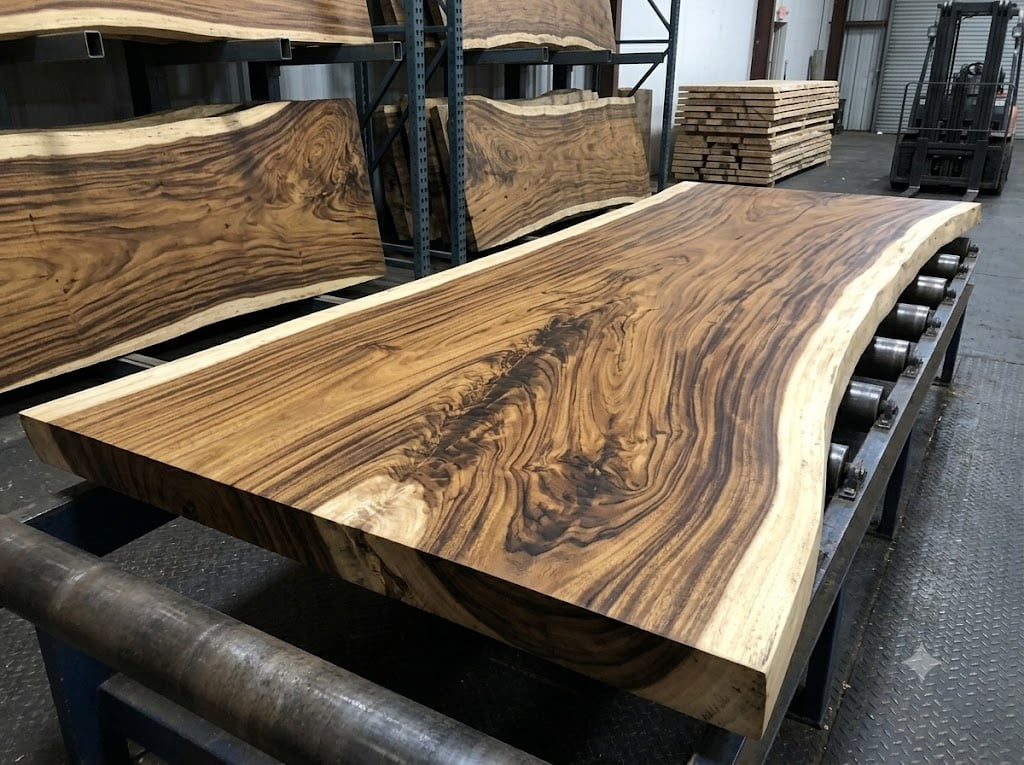
# Solid Parota Wood vs Parota Veneered Plywood: Complete Buyer’s Guide for Furniture and Millwork Applications
The explosive growth in parota wood’s international popularity has created a sophisticated market offering two fundamentally different material formats: **solid parota lumber** and **parota veneered plywood**. For furniture manufacturers optimizing production costs, interior designers specifying custom millwork, cabinet makers balancing quality with pricing, architects designing high-end interiors, importers making inventory decisions, and procurement professionals sourcing for international production—understanding the critical differences between these formats directly impacts project success, profitability, and customer satisfaction.
Both materials deliver parota’s signature warm golden-brown color and dramatic grain figure, yet they represent entirely different product categories with distinct advantages, limitations, fabrication requirements, and cost structures. The choice isn’t simply “better versus cheaper”—it’s a strategic material selection affecting **structural performance, dimensional stability, fabrication efficiency, material yield, finishing results, durability, sustainability, and total project economics** from procurement through installation and end-use.
Many buyers make costly mistakes by selecting materials based solely on upfront cost without considering total project economics, fabrication efficiency, waste factors, application suitability, or long-term performance. A seemingly “expensive” solid wood choice may deliver better value than “cheap” plywood when properly matched to application requirements—and vice versa.
This comprehensive guide addresses critical questions: **What are the real performance differences? When does solid wood deliver superior value despite higher material cost? Where does plywood offer advantages beyond cost savings? How do fabrication requirements differ? What finishing considerations distinguish these formats? Which applications optimize each material’s strengths? How do total project costs compare when accounting for yield, labor, and waste? What quality grades exist? How do sourcing strategies differ?**
—
## Material Composition and Construction: What You’re Actually Buying
### Solid Parota Wood: Pure Hardwood Throughout
**Material Definition:**
Solid parota consists of 100% parota wood throughout the entire thickness—no layering, no substrate, no veneer facing. The material is homogeneous from face to face, retaining the natural cellular structure of the tree with grain pattern extending through full thickness. All natural characteristics—figure, color variation, mineral streaks, knots—are present throughout, not just on the surface.
**Source and Processing:**
– **Origin:** Milled directly from parota logs (*Enterolobium cyclocarpum*)
– **Primary sources:** Mexico (Jalisco, Nayarit, Sinaloa, Oaxaca, Chiapas), Guatemala, Honduras
– **Tree maturity:** Typically 20-40+ years for quality lumber
– **Processing:** Logs sawn into dimensional lumber at sawmill, then kiln-dried
**Available Forms and Dimensions:**
**Thickness Options:**
– **Thin stock:** 12-19mm (1/2″-3/4″)—limited availability
– **Standard furniture:** 25mm (1″), 32mm (5/4″), 38mm (1-1/2″)—most common
– **Heavy stock:** 50mm (2″), 75mm (3″), 100mm (4″)—table tops, structural members
– **Custom thickness:** Can be resawn from thicker stock
**Width Availability:**
– **Narrow:** 75-150mm (3″-6″)—economy pricing
– **Standard:** 150-250mm (6″-10″)—common inventory
– **Wide:** 300-500mm (12″-20″)—premium pricing
– **Extra-wide slabs:** 500-1200mm+ (20″-48″+)—live-edge material; super-premium
**Length Options:**
– **Short:** 1.0-1.8m (3′-6′)—lower grades
– **Standard:** 2.0-2.5m (6′-8′)—most common
– **Long:** 3.0-4.0m (10′-13′)—better yield; premium pricing
– **Extra-long:** 4.0m+ (13’+)—architectural applications
**Moisture Content (Critical Factor):**
– **Green (undried):** 40-60%+ MC—requires kiln drying
– **Air-dried:** 15-20% MC—needs further drying for interior use
– **Kiln-dried:** 8-12% MC—standard for furniture/interiors
– **Premium kiln-dried:** 6-8% MC—controlled drying; superior stability
**Quality Grades:**
**FAS (Firsts and Seconds)—Premium Grade:**
– **Requirements:** 83%+ clear face; boards 6″+ wide, 8’+ long
– **Characteristics:** Minimal knots; uniform color; consistent grain
– **Price premium:** 40-60% above common grades
– **Applications:** High-end furniture faces, visible surfaces, architectural millwork
**Select Grade:**
– **Requirements:** One face FAS quality; reverse may have minor defects
– **Price position:** 20-30% above common grades
– **Applications:** Cabinet doors, furniture where one face shows
**Common Grade (#1, #2 Common):**
– **Characteristics:** Contains knots, color variation, mineral streaks, character marks
– **Price advantage:** Baseline pricing; excellent value for character projects
– **Applications:** Rustic furniture, contemporary organic designs, cost-conscious projects
**Live-Edge Slabs (Specialty Category):**
– **Description:** Wide sections preserving natural bark edge from massive parota trunks
– **Typical width:** 600-1200mm (24″-48″+)
– **Premium:** 3-5x standard lumber pricing
– **Applications:** Contemporary tables, statement furniture, bar tops
– **Market strength:** Parota’s massive diameter creates exceptional slabs
### Parota Veneered Plywood: Engineered Panel Construction
**Material Definition:**
Parota veneered plywood consists of thin parota wood veneer bonded to multi-layer engineered substrate. The face layer is real parota wood, but the bulk of material thickness comes from cross-laminated core providing dimensional stability.
**Critical Construction Variables:**
**Core Type Options (Fundamentally Different Products):**
**1. Hardwood Plywood Core (Most Common for Furniture):**
**Structure:**
– **Face veneer:** Parota (0.4-0.6mm standard; 0.8-1.2mm premium)
– **Cross-bands:** 2-4 layers perpendicular hardwood veneers
– **Core:** Hardwood veneer center layer
– **Back veneer:** Balancer (parota or utility species)
– **Construction:** 5-ply, 7-ply, or 9-ply typical
**Characteristics:**
– **Stability:** Excellent—cross-grain construction prevents warping
– **Strength:** Good structural properties for furniture
– **Weight:** Moderate (varies with core species)
– **Screw holding:** Good with proper techniques
– **Machining:** Works like hardwood; familiar techniques
**Core Species Variations:**
– **Eucalyptus:** Common; good stability; moderate cost
– **Okoume:** Lightweight; excellent workability; premium cost
– **Birch:** Dense; superior stability; highest cost
– **Mixed hardwoods:** Economy; variable quality
**2. MDF Core (Medium Density Fiberboard):**
**Structure:**
– **Face/back:** Parota veneer bonded to MDF substrate
– **Core:** Compressed wood fiber (homogeneous density)
– **Construction:** 3-layer (veneer-MDF-veneer)
**Characteristics:**
– **Surface quality:** Extremely flat—excellent for veneering
– **Stability:** Excellent dimensional stability
– **Density:** Heavy (denser than hardwood plywood)
– **Machining:** Excellent for routing; produces fine dust
– **Edge treatment:** Requires edge banding (exposed MDF unattractive)
– **Screw holding:** Good in face; poor in edges
– **Moisture sensitivity:** Higher than hardwood core
**Best for:** Cabinet doors, wall panels, applications requiring perfect flatness
**Avoid for:** Structural applications, moisture-prone environments
**3. Blockboard/Lumber Core:**
**Structure:**
– **Core:** Solid wood strips edge-glued (typically softwood)
– **Cross-bands:** Veneer layers between core and face
– **Face:** Parota veneer
**Characteristics:**
– **Weight:** Lighter than hardwood plywood/MDF
– **Screw holding:** Excellent in edges (solid wood core)
– **Strength:** Good bending strength
– **Stability:** Good but less than cross-grain plywood
– **Applications:** Table tops, large doors, shelving
**4. Bamboo Core (Sustainable Alternative):**
**Structure:**
– **Core:** Cross-laminated bamboo plies
– **Face:** Parota veneer
**Characteristics:**
– **Sustainability:** Bamboo rapidly renewable (3-5 years)
– **Stability:** Excellent
– **Strength:** High strength-to-weight ratio
– **Cost:** Premium (sustainability value)
– **Availability:** Limited; specialty suppliers
**Face Veneer Thickness (Critical Quality Factor):**
**Paper-Thin (0.2-0.4mm)—Economy Grade:**
– **Limitations:** Shows substrate telegraphing; minimal sanding possible
– **Refinishing:** Not practical—too thin
– **Applications:** Economy furniture, decorative panels only
– **Assessment:** Avoid for quality furniture
**Standard Commercial (0.4-0.6mm)—Industry Standard:**
– **Characteristics:** Adequate for most applications
– **Sanding capacity:** Limited—one light refinish possible with care
– **Refinishing:** Possible once; risk of sanding through
– **Applications:** Standard furniture, cabinets, architectural panels
– **Assessment:** Acceptable for quality furniture; industry baseline
**Premium/Heavy (0.8-1.2mm)—Superior Grade:**
– **Characteristics:** Substantial feel; allows significant finishing
– **Sanding capacity:** Good—multiple refinishes possible
– **Refinishing:** Excellent potential; similar to thin solid wood
– **Cost premium:** 30-50% above standard thickness
– **Assessment:** Preferred for premium applications
**Thick Veneer (1.5-3.0mm)—Near-Solid Quality:**
– **Characteristics:** Substantial wood layer; multiple refinishing cycles
– **Sanding capacity:** Excellent; like solid wood
– **Cost premium:** 50-100% above standard; approaching solid costs
– **Assessment:** Premium product; blurs veneer/solid distinction
**Panel Size Standards:**
– **4′ x 8′ (1220 x 2440mm):** Most common; standard sizing
– **5′ x 10′ (1525 x 3050mm):** Better yield for some applications
– **4′ x 10′ (1220 x 3050mm):** Architectural applications
– **Custom sizes:** Available with minimum orders
**Thickness Options:**
– **Thin:** 3mm, 5mm, 6mm—wall panels, decorative applications
– **Standard:** 9mm, 12mm, 15mm, 18mm—cabinets, furniture components
– **Heavy:** 21mm, 25mm, 30mm—table tops, thick applications
**Quality Grades:**
**AA Grade (Premium):**
– **Face quality:** Book-matched or slip-matched veneer
– **Color matching:** Tight consistency within and between panels
– **Price premium:** 40-60% above standard
– **Applications:** Highest-end furniture, luxury millwork
**A Grade (Select):**
– **Face quality:** Matched veneer; minor variation acceptable
– **Price position:** 20-30% above standard
– **Applications:** Quality furniture and millwork
**B Grade (Standard):**
– **Face quality:** Unmatched veneer; visible variation
– **Price:** Baseline commercial pricing
– **Applications:** Standard commercial furniture
—
## Visual Appearance: Aesthetic Differences That Matter
### Color and Figure Presentation
**Solid Parota:**
**Depth and Authenticity:**
– **Color penetration:** Golden-brown extends through entire thickness
– **Edge visibility:** Cut edges show same color as face—authentic appearance
– **Three-dimensional quality:** Grain figure has genuine depth; light interacts naturally with wood structure
– **Chatoyance effect:** Figure produces shifting highlights as viewing angle changes—only possible with solid wood depth
**Color Variation:**
– **Natural variation:** Boards show natural color differences (golden-tan to deep caramel)
– **Character marks:** Mineral streaks, sap stains, color zones add organic character
– **Design consideration:** Requires careful selection and arrangement for uniform appearance OR embrace variation for character aesthetic
**Figure and Grain:**
– **Dramatic grain:** Parota exhibits spectacular swirling grain, especially in crotch and burl sections
– **Figure depth:** Grain patterns appear three-dimensional due to actual depth
– **Uniqueness:** Each board genuinely unique; impossible to replicate
– **Premium figure:** Highly figured boards command significant premiums
**Parota Veneered Plywood:**
**Surface Appearance:**
– **Face quality:** Face veneer displays parota’s characteristic color and grain
– **Visual impact:** From front view, quality plywood closely resembles solid wood
– **Limitation:** Thin veneer layer means reduced three-dimensional depth
– **Figure presentation:** Grain figure visible but lacks deep chatoyance of solid wood
**Edges (Critical Aesthetic Difference):**
– **Edge appearance:** Cut edges expose substrate layers—clearly not solid wood
– **Visual solution:** Requires edge banding (solid wood strips, veneer edge tape, or PVC banding)
– **Edge banding quality:** Premium applications use solid parota edge banding for seamless appearance
– **Economy approach:** Veneer edge tape or colored PVC—lower cost but less authentic
**Consistency Advantages:**
– **Color matching:** Manufacturers pre-select veneers for consistent color/figure
– **Panel-to-panel:** Multiple panels show better consistency than solid lumber
– **Predictability:** Less variation simplifies design and specification
– **Large surfaces:** Easier to achieve uniform appearance across large areas
**Matching Patterns (Premium Grades):**
– **Book-matched:** Adjacent veneers opened like book for symmetrical mirror pattern
– **Slip-matched:** Veneers laid in sequence; creates continuous grain flow
– **Random-matched:** Veneers arranged without pattern; standard commercial approach
– **Premium value:** Matched patterns create refined, intentional aesthetic
### Detecting Quality Differences
**Solid Wood Identification:**
✅ **End grain visible:** Cut edges show genuine wood end grain structure
✅ **Consistent color:** Edges and faces show same color (natural variation expected)
✅ **Three-dimensional figure:** Grain has genuine depth when viewed at angles
✅ **Weight appropriate:** Solid parota has moderate density; feels substantial
✅ **Edge options:** Edges can be shaped, routed, carved—full design freedom
**Plywood Identification:**
⚠️ **Layered edges:** Cut edges show distinct substrate layers
⚠️ **Different edge color:** Core differs from face veneer color
⚠️ **Surface-only figure:** Grain pattern only on surface; no depth
⚠️ **Edge banding required:** Need to cover exposed substrate edges
⚠️ **Sanding limitations:** Can’t sand deeply without exposing substrate
—
## Structural Performance and Engineering Properties
### Load-Bearing Capacity and Strength
**Solid Parota Wood:**
**Mechanical Properties:**
– **Density:** 450-550 kg/m³ (28-34 lbs/ft³)—moderate density hardwood
– **Bending strength:** Moderate—suitable for most furniture applications
– **Compression strength:** Good for structural members, legs, frames
– **Hardness:** Janka 550-700 (softer than oak but adequate for furniture)
– **Impact resistance:** Moderate; can dent but generally durable
**Structural Characteristics:**
– **Grain direction:** Strength primarily along grain direction; weak across grain
– **Thickness advantage:** Available in heavy thicknesses (50-100mm+) for structural demands
– **Solid section:** Entire cross-section contributes to strength; no weak substrate layers
– **Joint strength:** Excellent glue joints; strong mechanical joints (mortise-tenon, dovetails)
**Application Suitability:**
– **Table tops:** Excellent—especially thick tops (38-50mm) for large tables
– **Structural frames:** Good for chair/table frames, bed frames, structural furniture components
– **Shelving:** Good load-bearing for long spans (requires adequate thickness)
– **Legs and posts:** Excellent—solid wood ideal for turned or carved legs
**Parota Veneered Plywood:**
**Mechanical Properties (Hardwood Core):**
– **Density:** 550-700 kg/m³ (34-44 lbs/ft³)—varies by core species; generally denser than solid parota
– **Bending strength:** Excellent—cross-grain construction provides multidirectional strength
– **Stiffness:** Superior to solid wood of equivalent thickness due to engineered construction
– **Dimensional rigidity:** Resists sagging better than solid wood panels
– **Core dependence:** Properties vary significantly based on core type (hardwood vs MDF vs blockboard)
**Structural Characteristics:**
– **Mult
Comments