
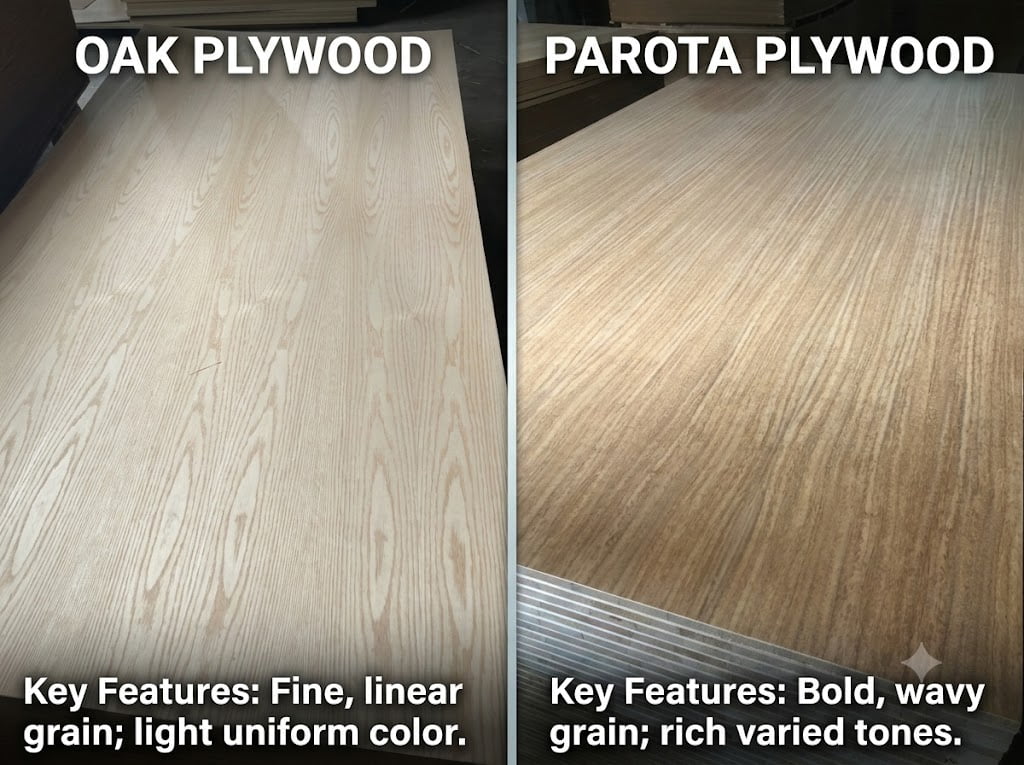
# Parota Plywood vs Oak Plywood: Complete Comparison Guide for Buyers and Specifiers
The global wood plywood market presents specifiers, architects, furniture manufacturers, millwork fabricators, contractors, and importers with an expanding array of species choices—each promising distinct aesthetic characteristics, performance attributes, cost advantages, and market positioning. As natural resource availability shifts, consumer preferences evolve, design trends change, and supply chain dynamics transform, the strategic question facing industry professionals becomes increasingly complex: **Which species delivers optimal value—balancing appearance, performance, availability, and economics—for specific applications and target markets?**
Two hardwood plywood options attracting growing attention across residential construction, commercial interiors, furniture manufacturing, and architectural millwork markets represent distinctly different value propositions: **parota plywood**, sourced primarily from Mexico and Central America, and **oak plywood**, available in both North American red/white oak and European oak varieties. Each species brings recognized strengths: oak’s established market position, familiar appearance, and proven performance track record versus parota’s distinctive aesthetic character, emerging availability, and competitive pricing structure.
Yet despite both species’ increasing specification in overlapping applications—interior wall paneling, cabinet construction, furniture production, architectural millwork, decorative installations—comprehensive comparative analysis addressing practical selection criteria remains limited. Buyers evaluating these options need answers to specific questions that directly impact procurement decisions, project success, and business outcomes: How do appearance characteristics compare, and which markets prefer each aesthetic? What performance differences affect specific applications? How do availability, pricing, and supply chain reliability compare across regions? Which species delivers superior value for particular project types, quality tiers, and budget constraints? What practical considerations—finishing, machining, installation—differentiate the two options?
This definitive comparison guide addresses these questions systematically, examining parota and oak plywood across eight critical evaluation dimensions: aesthetic characteristics and design appeal, technical performance specifications, machining and fabrication properties, finishing requirements and results, application-specific suitability, market positioning and pricing, availability and sourcing considerations, and environmental/sustainability factors. Rather than declaring a single “winner,” this analysis equips readers with the comparative framework to make informed species selections based on their specific requirements, priorities, and market contexts.
Whether you’re a **furniture manufacturer** optimizing material costs while maintaining market positioning; an **architect or designer** balancing aesthetic vision with project budget and performance requirements; an **importer or distributor** evaluating inventory investment decisions; a **contractor or millwork fabricator** seeking reliable materials that machine efficiently and install predictably; or a **procurement professional** negotiating with suppliers across international markets—this comprehensive resource provides the comparative intelligence required for confident decision-making.
—
## Species Overview: Origins, Characteristics, and Market Context
### Parota (Enterolobium cyclocarpum)
**Botanical and Commercial Names:**
– **Scientific name:** Enterolobium cyclocarpum
– **Common names:** Parota, guanacaste, parota wood, monkey ear tree, elephant ear tree
– **Trade names:** Mexican walnut (misleading—not related to true walnut)
– **Family:** Fabaceae (legume family)
**Geographic Origin and Distribution:**
**Native Range:**
– **Primary:** Mexico (Pacific coast, Yucatan Peninsula)
– **Extended:** Central America (Guatemala, Honduras, Costa Rica, El Salvador)
– **Cultivation:** Southern Mexico plantations; scattered throughout Central America
– **Climate zones:** Tropical and subtropical regions; elevations 0-1200 meters
**Growing Characteristics:**
– **Growth rate:** Fast-growing (reaches merchantable size 20-30 years)
– **Tree size:** Large tree; 25-40 meters height; trunk diameter 1-3 meters
– **Form:** Wide-spreading crown; impressive ornamental value
– **Sustainability advantage:** Relatively fast regeneration compared to slow-growing hardwoods
**Historical and Contemporary Use:**
**Traditional Applications:**
– **Local construction:** Door and window frames in traditional Mexican architecture
– **Furniture:** Central American furniture traditions utilize parota extensively
– **Carving:** Valued for decorative carving due to workability
– **Boatbuilding:** Historical use in canoe construction
**Contemporary Market Development:**
– **Export growth:** Increasing exports to U.S., Canada, Europe since 2010s
– **Market positioning:** Emerging as mid-to-upper-tier tropical hardwood alternative
– **Design adoption:** Growing specification by architects, designers seeking distinctive appearance
– **Furniture industry:** Expanding use in contemporary and rustic furniture lines
### Oak (Quercus species)
**Botanical and Commercial Classification:**
**Two Primary Types in Plywood Market:**
**1. Red Oak (Quercus rubra – North American):**
– **Primary source:** United States (Midwest, Northeast, Appalachian regions)
– **Secondary source:** Canada (Ontario, Quebec)
– **Characteristics:** Open grain, pink-brown color, prominent ray fleck
– **Market position:** Standard North American hardwood; widely available
**2. White Oak (Quercus alba – North American):**
– **Primary source:** United States (same regions as red oak, plus Southeast)
– **Characteristics:** Closed grain (more moisture-resistant), gray-brown color, more subtle ray fleck
– **Market position:** Premium over red oak; preferred for moisture-exposed applications
– **Price premium:** 15-25% more expensive than red oak
**3. European Oak (Quercus robur, Quercus petraea):**
– **Primary sources:** Germany, France, Poland, Croatia, Ukraine, Russia
– **Characteristics:** Straighter grain than American oak, lighter color, tighter grain
– **Market position:** Premium imported species in North American market; standard in Europe
– **Price premium:** 30-50% more expensive than American red oak in U.S. market
**Historical Significance:**
**European and American History:**
– **Construction heritage:** Oak timbers formed structural foundation of buildings for centuries
– **Furniture tradition:** Oak furniture dominant from medieval period through Arts & Crafts movement
– **Shipbuilding:** Oak ships formed naval forces; “hearts of oak” reference
– **Cultural symbolism:** Strength, permanence, tradition across Western cultures
**Contemporary Market Position:**
**Established Market Leadership:**
– **Volume:** Oak plywood represents largest market share among hardwood plywoods in North America and Europe
– **Availability:** Extensive supply chain; available from numerous suppliers
– **Standardization:** Well-established grading standards, specifications, quality expectations
– **Familiarity:** Buyers, designers, consumers thoroughly familiar with oak characteristics
**Market Segments:**
– **Residential construction:** Kitchen cabinets, built-ins, interior millwork
– **Furniture manufacturing:** Case goods, tables, seating frames
– **Commercial interiors:** Office furniture, retail fixtures, hospitality millwork
– **Architectural millwork:** Wall panels, wainscoting, decorative elements
—
## Visual Comparison: Aesthetic Characteristics and Design Impact
For designers, architects, and end-users, **visual appearance** often drives initial species preference. Understanding aesthetic differences enables informed decisions about which species aligns with project design intent.
### Color Characteristics
**Parota Plywood:**
**Color Range:**
– **Heartwood:** Golden brown to rich caramel brown; medium-dark tones
– **Sapwood:** Pale cream to light tan (often excluded from face veneers or positioned at edges)
– **Spectrum:** Warm golden to tobacco brown without cool undertones
– **Color variation:** Moderate variation within panels; trees from different regions show color differences
– **Undertones:** Honey, amber, golden highlights—purely warm spectrum
**Visual Character:**
– **Richness:** Substantial color depth without heaviness of walnut
– **Warmth level:** High—among warmest brown-toned hardwoods
– **Brightness:** Moderate reflectivity; not dark like walnut, not pale like maple
– **Consistency:** Relatively uniform within individual panels; batch-to-batch variation possible
**Color Evolution:**
– **UV exposure:** Gradually darkens and enriches with light exposure over time
– **Oxidation:** Develops attractive patina; golden tones mature to deeper caramel
– **Finish impact:** Oil finishes immediately deepen color; water-based finishes preserve lighter tones longer
– **Long-term appearance:** Becomes richer, warmer over years—attractive aging
**Oak Plywood:**
**Red Oak:**
– **Heartwood:** Pinkish-brown to pale reddish-brown
– **Sapwood:** Nearly white to pale cream (often mixed with heartwood in commercial veneers)
– **Spectrum:** Cooler tones than parota; pink/red undertones
– **Color variation:** Minimal within species; highly consistent
– **Character:** Neutral, familiar, traditional
**White Oak:**
– **Heartwood:** Light to medium brown with gray undertones
– **Sapwood:** Light gray-brown to pale tan
– **Spectrum:** Cool, gray-toned—distinctly different from warm woods
– **Color variation:** Very consistent
– **Character:** Refined, subtle, elegant
**European Oak:**
– **Heartwood:** Pale yellow-brown to light tan
– **Overall tone:** Lighter than American oaks; golden-tan rather than brown
– **Spectrum:** Neutral to slightly warm
– **Character:** Light, bright, Scandinavian aesthetic
**Comparative Color Position:**
“`
COOL ←————————————————————→ WARM
White Oak ——— European Oak ——— Red Oak ————————— Parota
(Gray-Brown) (Light Tan) (Pink-Brown) (Golden-Brown)
“`
**Design Implications:**
**Parota Advantages:**
✅ **Warmth:** Adds significant warmth to cool-toned interiors (gray walls, concrete, metal)
✅ **Richness:** Creates luxurious appearance without dark-wood heaviness
✅ **Resort aesthetic:** Evokes tropical, vacation, boutique hotel ambiance
✅ **Trend alignment:** Aligns with current preference for warm, natural tones
**Oak Advantages:**
✅ **Versatility:** Neutral tones coordinate with any color palette
✅ **Tradition:** Familiar appearance reassures conservative buyers
✅ **Brightness:** White/European oak maintains light, airy spaces
✅ **Contemporary:** Gray-toned white oak suits modern minimalist designs
### Grain Pattern and Figure
**Parota Plywood:**
**Grain Structure:**
– **Type:** Interlocked grain (grain direction alternates in successive growth layers)
– **Pattern:** Irregular, swirling, dynamic—varies significantly within panels
– **Figure types:**
– **Cathedral/crown:** Large arched patterns on flat-sawn faces
– **Swirl/flame:** Dramatic swirling patterns where grain shifts direction
– **Ribbon:** Alternating light/dark bands created by interlocked grain
– **Visual activity:** High—busy, dynamic, visually engaging
– **Predictability:** Lower—significant variation panel-to-panel
**Unique Characteristics:**
**Chatoyance (Light Play):**
– **Description:** Surface appearance changes with viewing angle as light reflects differently off alternating grain directions
– **Effect:** Wood appears to shimmer, have depth, movement
– **Visual impact:** Creates three-dimensional quality; “alive” appearance
– **Premium perception:** Distinguishes real wood from synthetic materials
**Grain Scale:**
– **Texture:** Medium to coarse grain texture
– **Pore size:** Medium-large open pores (similar to oak)
– **Visual prominence:** Grain highly visible; becomes design feature
**Oak Plywood:**
**Grain Structure:**
**Red Oak:**
– **Type:** Straight grain with prominent ray fleck
– **Pattern:** Regular, predictable, linear
– **Ray fleck:** Large medullary rays visible as flakes/ribbons across grain (distinctive oak feature)
– **Visual activity:** Moderate to high depending on cut
– **Texture:** Coarse, open grain; large pores
**White Oak:**
– **Type:** Similar to red oak but often slightly straighter
– **Pattern:** Linear with prominent rays
– **Ray fleck:** More subtle than red oak; finer scale
– **Visual activity:** Moderate
– **Texture:** Medium-coarse grain
**European Oak:**
– **Type:** Very straight grain
– **Pattern:** Linear, regular, refined
– **Ray fleck:** Fine, subtle rays
– **Visual activity:** Low to moderate
– **Texture:** Finer grain than American oaks
**Cut Variations (All Oak Types):**
**Quarter-Sawn Oak:**
– **Grain orientation:** Vertical grain with dramatic ray fleck display
– **Appearance:** Straight lines with ribbon/flake figure
– **Visual style:** Formal, traditional, Arts & Crafts aesthetic
– **Premium:** 40-60% price premium over plain-sawn
– **Design appeal:** Distinctive, recognizable pattern
**Plain-Sawn (Flat-Sawn) Oak:**
– **Grain orientation:** Cathedral patterns from growth ring curves
– **Appearance:** Arched grain patterns, less ray fleck prominence
– **Visual style:** Traditional, familiar
– **Standard:** Typical commercial grade; widely available
– **Design appeal:** Classic oak appearance
**Rift-Sawn Oak:**
– **Grain orientation:** Linear grain, minimal ray fleck
– **Appearance:** Clean, straight grain lines
– **Visual style:** Contemporary, minimalist
– **Premium:** 30-50% price premium
– **Design appeal:** Modern, refined
**Comparative Grain Character:**
| **Characteristic** | **Parota** | **Red Oak** | **White Oak** | **European Oak** |
|——————-|———–|————|————–|—————–|
| **Grain Pattern** | Interlocked, irregular | Straight, consistent | Straight, consistent | Very straight |
| **Visual Activity** | High (dynamic) | Moderate-High | Moderate | Low-Moderate |
| **Predictability** | Low (variable) | High (consistent) | High (consistent) | Very High |
| **Figure Complexity** | Complex, varied | Moderate (ray fleck) | Moderate (subtle rays) | Simple, refined |
| **Contemporary Appeal** | ★★★★★ | ★★★☆☆ | ★★★★☆ | ★★★★★ |
| **Traditional Appeal** | ★★☆☆☆ | ★★★★★ | ★★★★★ | ★★★★☆ |
| **Visual Drama** | ★★★★★ | ★★★☆☆ | ★★★☆☆ | ★★☆☆☆ |
**Design Implications:**
**Parota Advantages:**
✅ **Statement piece:** High visual drama creates focal points
✅ **Uniqueness:** Each panel distinctly different; one-of-a-kind quality
✅ **Contemporary:** Irregular patterns suit modern, organic design approaches
✅ **Visual interest:** Provides decoration without applied ornamentation
**Oak Advantages:**
✅ **Predictability:** Designers know what appearance to expect
✅ **Consistency:** Uniform appearance across large projects
✅ **Coordination:** Grain pattern doesn’t compete with other design elements
✅ **Formality:** Quarter-sawn oak provides refined, formal aesthetic
### Texture and Surface Quality
**Parota Plywood:**
**Tactile Characteristics:**
– **Surface feel:** Smooth when sanded; grain slightly raised with open pores
– **Pore structure:** Open grain (medium-large pores)—similar prominence to oak
– **Filling requirements:** Benefits from grain filling for glass-smooth finish
– **Natural surface:** Pleasant tactile quality; warm feel
**Finishing Considerations:**
– **Smooth applications:** Requires pore filling for perfectly smooth finish (cabinet doors, tabletops)
– **Textured applications:** Natural texture acceptable for rustic, organic designs
– **Sanding response:** Sands well; accepts fine grits for smooth surface
– **Chatoyance enhancement:** Smooth finish maximizes light-play effect
**Oak Plywood:**
**Tactile Characteristics:**
**Red Oak:**
– **Surface feel:** Coarse texture; prominent open grain
– **Pore structure:** Large, open pores—most pronounced grain of common hardwoods
– **Filling requirements:** Absolutely requires grain filling for smooth finish
– **Natural surface:** Rough, textured feeling
**White Oak:**
– **Surface feel:** Slightly smoother than red oak but still open-grained
– **Pore structure:** Medium-large pores, somewhat closed by tyloses
– **Filling requirements:** Needs filling for smooth finish
– **Natural surface:** Moderately textured
**European Oak:**
– **Surface feel:** Finer than American oaks; less pronounced texture
– **Pore structure:** Tighter grain structure
– **Filling requirements:** Less filling needed than American species
– **Natural surface:** Smoother natural feel
**Comparative Texture:**
“`
FINE/SMOOTH ←————————————————————→ COARSE/TEXTURED
European Oak —— White Oak ——— Parota ———— Red Oak
“`
**Practical Implications:**
**For High-Gloss Applications (Piano finish, high-end cabinetry):**
– **All species require grain filling**
– **Red oak:** Most labor-intensive to achieve perfect smoothness
– **Parota:** Moderate effort for smooth finish
– **European oak
Comments